
How to Calculate Your Age in Hijri (and Why It Is Higher Than Your Gregorian Age)
Your Hijri age is always higher than your Gregorian age, by almost a full year every 33 years. Here is the step-by-step method, a table of the gap by age, and a free calculator.
To calculate your age in Hijri, convert your date of birth to the Hijri (Umm al-Qura) calendar, then subtract it from today's Hijri date in years, months and days. You will find that your Hijri age is always higher than your Gregorian age: the Hijri year is about 11 days shorter, so the gap builds up to a full year roughly every 33 years.
The easiest way is the Hijri Age Calculator below: enter your date of birth in either calendar to get your exact age in both, the weekday you were born, the number of days you have lived and your next birthday.
Age Calculator in Hijri and Gregorian
Open the full toolWhy Is Your Hijri Age Higher?
A Gregorian year averages 365.24 days, while a Hijri year is about 354.37 days. So every Gregorian year you live equals roughly 1.03 Hijri years. The gap grows with time: about 4 months at age 10, about 11 months at 30, and more than two years after 70.
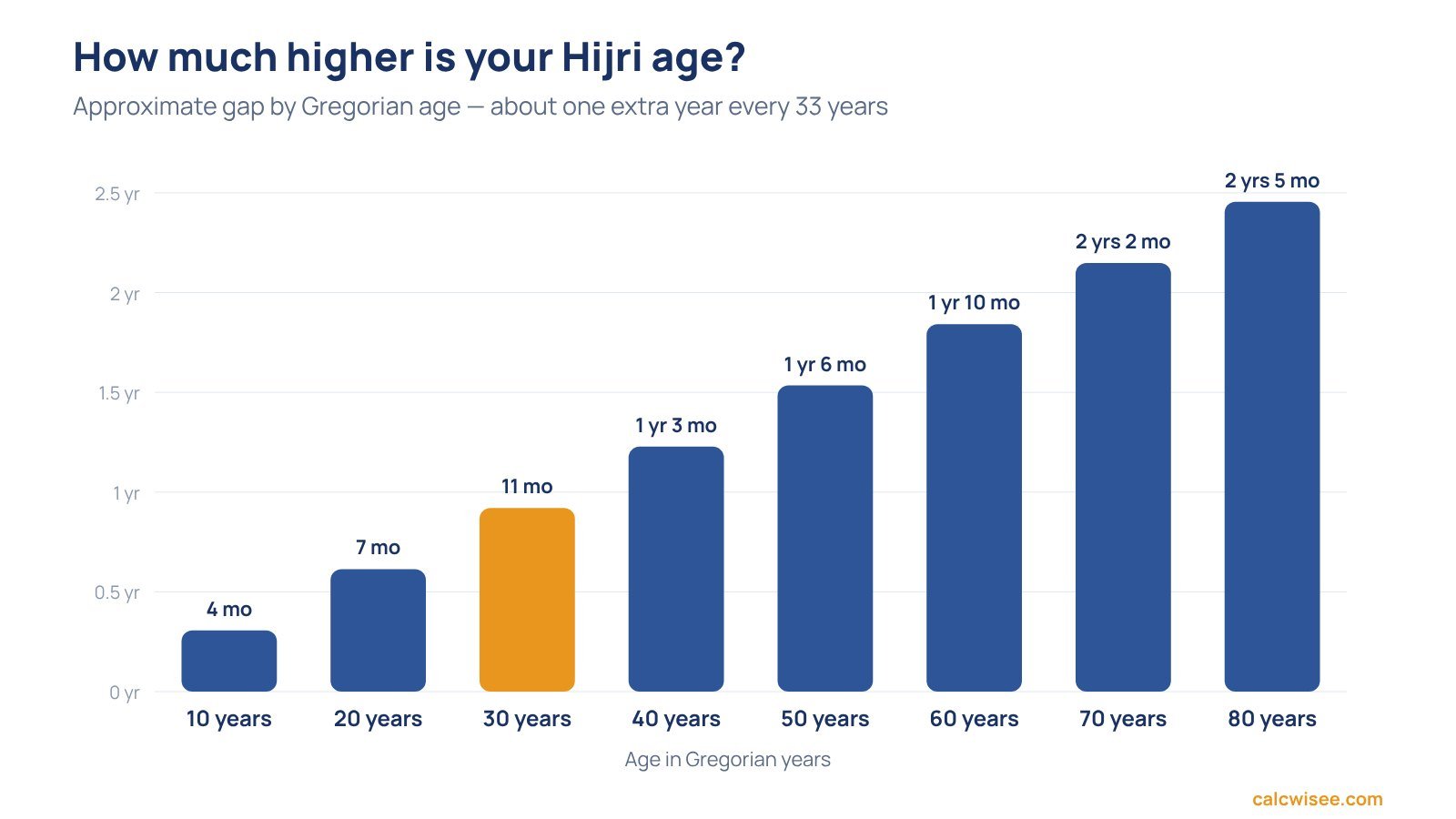
Quick rule
Hijri age ≈ Gregorian age × 1.0307
1.0307 is 365.24 divided by 354.37. Example: 40 × 1.0307 ≈ 41.2 Hijri years, about 41 years and 3 months.
How to Calculate Your Hijri Age Step by Step
- 1Convert your date of birth to Hijri if you only know the Gregorian date, using the date converter. Example: 15 June 1995 is 16 Muharram 1416 AH.
- 2Find today's Hijri date on the Today's Hijri Date page. In our example, 5 November 2026 is 25 Jumada al-Ula 1448 AH.
- 3Subtract the days: 25 − 16 = 9 days. If today's day is smaller than the birth day, borrow a month and add the length of the previous Hijri month (29 or 30).
- 4Subtract the months: Jumada al-Ula (5) − Muharram (1) = 4 months. If the result is negative, borrow a year and add 12 months.
- 5Subtract the years: 1448 − 1416 = 32 years. Result: 32 years, 4 months and 9 days in Hijri.
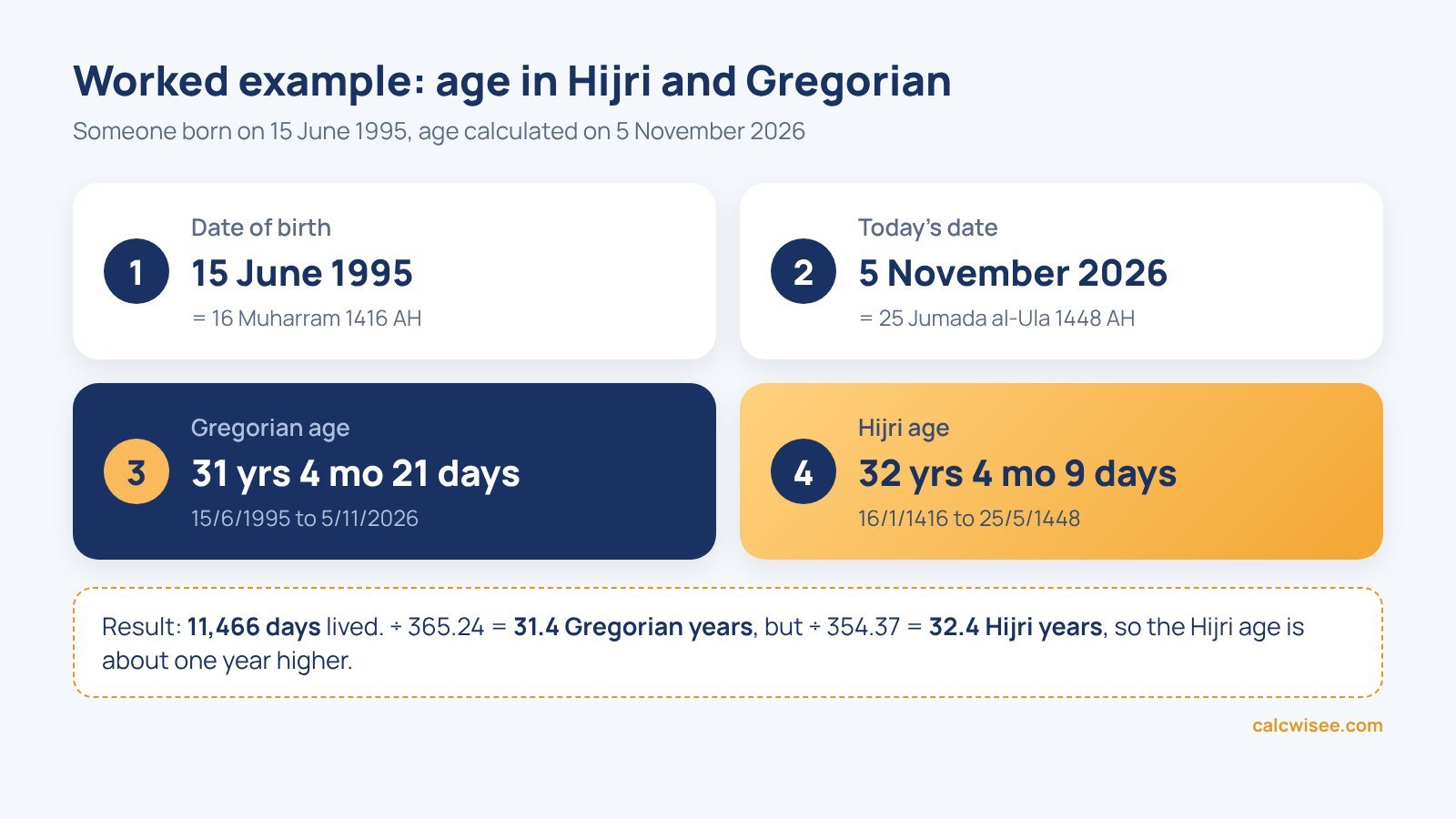
The same method in Gregorian, from 15 June 1995 to 5 November 2026: because 5 is smaller than 15 we borrow a month (October, 31 days): 5 + 31 − 15 = 21 days, then 10 − 6 = 4 months, then 2026 − 1995 = 31 years.
Quick check
Gregorian to Hijri Age Table
For a quick estimate without calculating, this table gives the Hijri age for common Gregorian ages:
| Gregorian age | Approximate Hijri age | Difference |
|---|---|---|
| 10 years | 10 years 4 months | 4 months |
| 18 years | 18 years 7 months | 7 months |
| 20 years | 20 years 7 months | 7 months |
| 25 years | 25 years 9 months | 9 months |
| 30 years | 30 years 11 months | 11 months |
| 33 years | 34 years | 1 full year |
| 40 years | 41 years 3 months | 1 year 3 months |
| 50 years | 51 years 6 months | 1 year 6 months |
| 60 years | 61 years 10 months | 1 year 10 months |
| 65 years | 67 years | 2 years |
| 70 years | 72 years 2 months | 2 years 2 months |
The table uses averages; the exact gap can differ by a few days depending on your birth date.
Why the Difference Matters
Someone born on 10 March 2008 (2 Rabi al-Awwal 1429 AH) is 18 years and 7 months old in Gregorian on 5 November 2026, but 19 years and 2 months in Hijri. If an organisation sets an age requirement, check which calendar it uses before you apply.
When Do You Need Your Hijri Age?
- Official procedures and forms: some systems set age limits or ask for a Hijri date of birth; the organisation concerned is always the reference.
- Islamic rulings: religious calculations use lunar months, including the zakat year, which is counted in Hijri years.
- Your Hijri birthday: some people celebrate their Hijri birth date, which comes about 11 days earlier each Gregorian year.
- Children's exact ages: for vaccinations, school admission and activities that depend on age.
- Curiosity: many people are surprised to find they are a full year older in the Hijri calendar.
When Is Your Hijri Birthday?
Because the Hijri year is shorter, your Hijri birthday comes about 11 days earlier on the Gregorian calendar every year. In our example the next Gregorian birthday is 15 June 2027, while the Hijri birthday (16 Muharram 1449 AH) falls on Monday 21 June 2027. After a few years the Hijri birthday will come weeks, then months, before the Gregorian one.
Common Mistakes in Calculating Hijri Age
- Subtracting the years only: 1448 − 1416 gives 32, but if your Hijri birthday has not come yet this year, you are only 31.
- Assuming every month has 30 days: a Hijri month has 29 or 30 days, which changes the day count when you borrow.
- Multiplying by a fixed factor and rounding: the 1.0307 rule is an estimate; for official papers, calculate from the dates themselves.
- Using a different Hijri calendar: arithmetic calendars or other countries' calendars can differ by a day from Umm al-Qura, changing the age in days.
- Forgetting the time zone: outside Saudi Arabia the date can differ near midnight; the Today's Hijri Date page can show Makkah time.
Frequently Asked Questions
How do I calculate my age in Hijri?
Convert your date of birth to Hijri, then subtract it from today's Hijri date in years, months and days. Or use the Hijri Age Calculator, which does it automatically with the Umm al-Qura calendar.
How old am I in Hijri if I am 30 in Gregorian years?
About 30 years and 11 months in Hijri. The quick rule: multiply your Gregorian age by 1.0307.
Why is my Hijri age higher than my Gregorian age?
Because the Hijri year is about 11 days shorter than the Gregorian year, and the gap builds up to a full year roughly every 33 years.
Can I calculate my Hijri age from a Gregorian birth date?
Yes. Choose "Gregorian" in the calculator and enter your date of birth; it converts it to Hijri and calculates your age in both calendars.
When is my Hijri birthday?
On the same Hijri date as your birth every year, which falls about 11 days earlier on the Gregorian calendar than the year before. The calculator shows the next one and the days left.
Does the calculator store my date of birth?
No. The calculation runs in your browser only, and your date of birth is never sent to a server.
How many days have I lived?
The calculator shows the total days since your birth and the number of weeks. For example, someone born on 15 June 1995 has lived 11,466 days by 5 November 2026.
Sources
- Umm al-Qura calendar — official site
- Islamic calendar — Wikipedia
- Tropical year — Wikipedia (average length of the solar year)
- Dates and ages in the examples are calculated with the same Umm al-Qura tables the CalcWisee calculator uses.