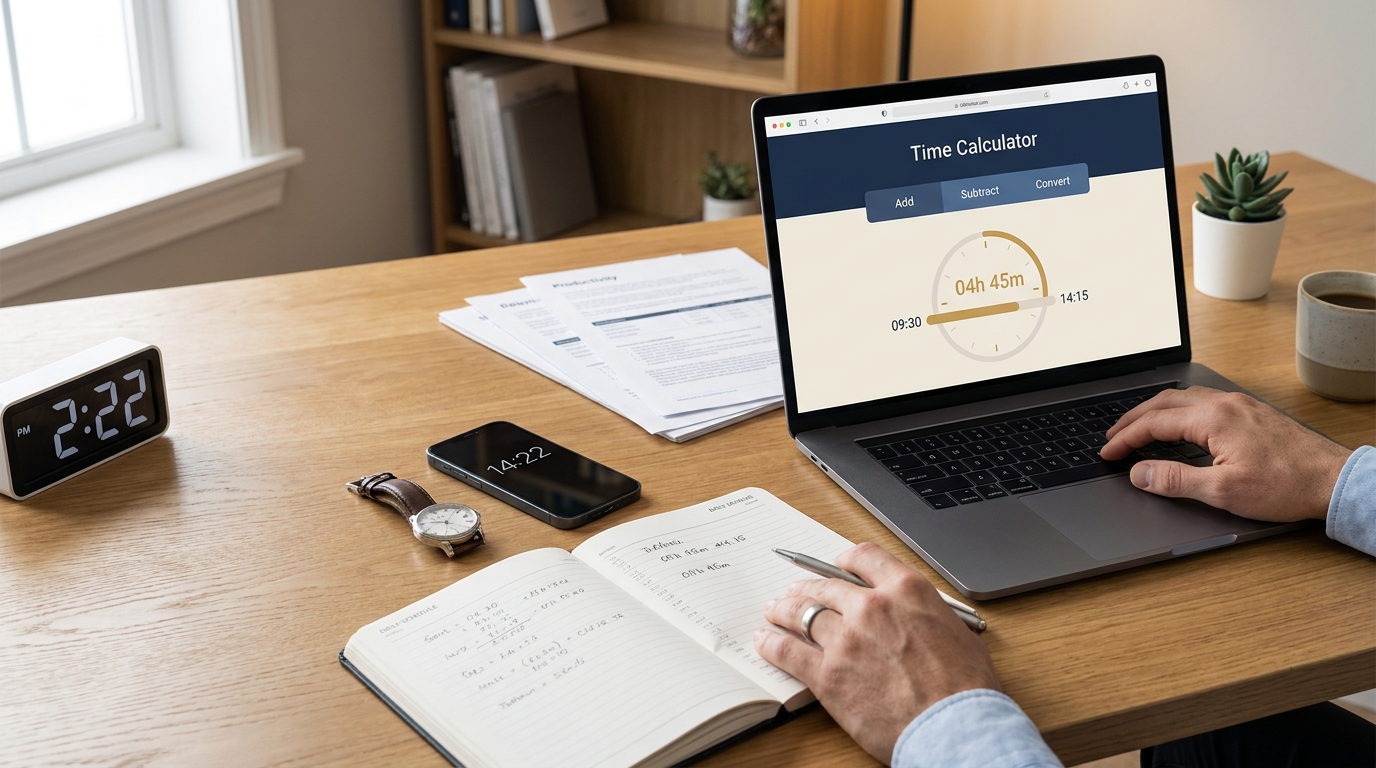
Time Calculator: Add, Subtract and Convert Time
Add and subtract hours, minutes, and seconds, find the difference between two clock times (including overnight), and convert decimal hours — with clear formulas and a free calculator.
Time math shows up everywhere — timesheets, study blocks, workouts, travel legs, and project estimates. Adding 2 hours 45 minutes to 1 hour 30 minutes is simple once, but easy to mis-carry when you do it all day.
Our free Time Calculator adds and subtracts durations, finds the difference between two clock times (including overnight), and converts between hours, minutes, seconds, and decimal hours — with formulas and steps on screen.
Try it right here — results update instantly.
Add hours, minutes, and seconds
Result
4h 15m
2h 45m + 1h 30m = 4h 15m
Formula: Total seconds = Σ (h×3600 + m×60 + s), then normalize
Sum all durations in seconds, then carry into hours, minutes, and seconds
- A: 2h 45m 0s = 9900 seconds
- B: 1h 30m 0s = 5400 seconds
- Sum: 9900 + 5400 = 15300 seconds
- Normalize → 4h 15m
- Hours
- 4
- Minutes
- 15
- Seconds
- 0
- Total minutes
- 255
- Total seconds
- 15300
- Decimal hours
- 4.25
Quick reference — hours to minutes
| Hours | Minutes | Seconds |
|---|---|---|
| 30 min | 1,800 s | |
| 60 min | 3,600 s | |
| 90 min | 5,400 s | |
| 120 min | 7,200 s | |
| 180 min | 10,800 s | |
| 300 min | 18,000 s | |
| 1,440 min | 86,400 s |
Quick examples — add & subtract
Learn more about time calculations — read our Time Calculator guide with formulas, midnight crossing, decimal hours, and workplace examples.
What Is a Time Calculator?
A Time Calculator is a tool that performs arithmetic on durations and clock times. Unlike a unit converter that only scales one quantity, a time calculator handles carry and borrow (60 seconds = 1 minute, 60 minutes = 1 hour) and special cases such as crossing midnight.
Typical jobs include:
- Adding work or study sessions (2h 45m + 1h 30m)
- Subtracting breaks from a shift (5h 20m − 2h 45m)
- Finding elapsed time between two clock times (9:30 AM to 2:15 PM)
- Converting decimal hours from payroll systems (1.5 h → 1h 30m)
How to Add Time
To add two durations, work from the smallest unit upward and carry whenever a unit reaches 60.
Example: 2 hours 45 minutes + 1 hour 30 minutes.
- 1Minutes: 45 + 30 = 75 minutes
- 275 minutes = 1 hour + 15 minutes (carry the hour)
- 3Hours: 2 + 1 + 1 (carry) = 4 hours
- 4Result: 4 hours 15 minutes
How to Add Hours, Minutes and Seconds
When seconds are involved, convert everything to total seconds (or add column by column with carry).
Example: 1h 25m 40s + 2h 45m 35s.
- Seconds: 40 + 35 = 75 s → 1 m + 15 s
- Minutes: 25 + 45 + 1 = 71 m → 1 h + 11 m
- Hours: 1 + 2 + 1 = 4 h
- Result: 4 hours 11 minutes 15 seconds
Equivalently: total seconds = 1×3600+25×60+40 + 2×3600+45×60+35 = 15,075 s → normalize to h:m:s.
How to Subtract Time
Subtract the same way you learned in school — borrow 60 minutes or 60 seconds when needed.
Example: 5 hours 20 minutes − 2 hours 45 minutes.
- 1Minutes: 20 is less than 45, so borrow 1 hour → 4 hours and 80 minutes
- 2Minutes: 80 − 45 = 35 minutes
- 3Hours: 4 − 2 = 2 hours
- 4Result: 2 hours 35 minutes
Another check: 4h 30m − 2h 45m = 1h 45m.
How to Calculate the Difference Between Two Times
Time difference answers “how long from start to end?” Convert both clock times to minutes (or seconds) from midnight, subtract, and normalize.
Example: 9:30 AM to 2:15 PM.
- 9:30 AM = 9×60 + 30 = 570 minutes from midnight
- 2:15 PM = 14×60 + 15 = 855 minutes from midnight
- Difference: 855 − 570 = 285 minutes = 4 hours 45 minutes
Time Conversion
Core relationships:
- 1 hour = 60 minutes
- 1 minute = 60 seconds
- 1 hour = 3,600 seconds
- Decimal hours × 60 = minutes (for the fractional part)
Example: 1.5 hours = 1 hour + 0.5×60 = 1 hour 30 minutes. Example: 3 hours = 180 minutes. Example: 1 hour = 3,600 seconds.
Common Time Conversion Table
| Hours | Minutes | Seconds |
|---|---|---|
| 0.5 hour | 30 min | 1,800 s |
| 1 hour | 60 min | 3,600 s |
| 1.5 hours | 90 min | 5,400 s |
| 2 hours | 120 min | 7,200 s |
| 3 hours | 180 min | 10,800 s |
| 5 hours | 300 min | 18,000 s |
| 24 hours | 1,440 min | 86,400 s |
Decimal Hours vs. Hours and Minutes
Payroll and billing systems often store time as decimal hours (7.5 h), while people speak in hours and minutes (7 h 30 m).
To convert decimal hours to h:m: take the whole number as hours; multiply the fractional part by 60 for minutes. Example: 0.75 hours → 0.75×60 = 45 minutes.
To convert h:m to decimal: hours + minutes÷60. Example: 4 h 15 m → 4 + 15/60 = 4.25 h.
Do not treat decimals as minutes
Time Calculations in the Workplace
Common workplace uses include summing billable hours, subtracting unpaid breaks, converting timesheet decimals, and estimating project effort across multiple sessions.
When several segments are involved, add them all in the calculator (or convert each to minutes first) rather than chaining mental arithmetic that drops a carry.
Time Calculator for Studying
Students use duration math for Pomodoro-style blocks, total weekly study hours, and exam countdown planning. Adding 45-minute sessions across a week is clearer when you normalize to hours and minutes at the end.
Time Calculator for Exercise
Workouts often mix warm-up, intervals, and cool-down. Adding 12 minutes warm-up + 28 minutes intervals + 10 minutes cool-down = 50 minutes total. Subtract rest if you only want moving time.
Time Calculations for Travel
Travel planning needs elapsed time between departure and arrival, multi-leg totals, and layover gaps. Always confirm whether times are local and whether the journey crosses midnight or a date line (this calculator handles same-zone midnight crossing; multi-zone trips need a time-zone tool as well).
Time Difference Across Midnight
If the end clock time is earlier than the start, the interval spans midnight. Add 24 hours to the end before subtracting.
Example: 11:00 PM to 2:00 AM → (2:00 AM + 24 h) − 11:00 PM = 3 hours.
| Start | End | Elapsed |
|---|---|---|
| 11:00 PM | 2:00 AM | 3 hours |
| 10:15 PM | 1:00 AM | 2 hours 45 minutes |
| 23:30 (24h) | 01:15 (24h) | 1 hour 45 minutes |
12-Hour vs. 24-Hour Time
12-hour clocks use AM/PM (2:15 PM). 24-hour clocks use 0–23 (14:15). Convert PM hours by adding 12 except for 12 PM (noon stays 12). 12 AM (midnight) is 00:00 in 24-hour form.
The Time Calculator Time Difference mode supports both formats so you can match the clock style you use day to day.
Common Time Calculation Mistakes
- Forgetting to carry when minutes exceed 59 (writing 3h 75m instead of 4h 15m)
- Treating decimal hours as hours-and-minutes (1.30 ≠ 1:30)
- Ignoring midnight crossing and getting a negative or huge wrong gap
- Mixing 12-hour and 24-hour inputs without converting
- Subtracting clock times as if they were plain decimals (2:15 − 9:30 is not −7.15)
Why Use an Online Time Calculator?
An online calculator removes carry/borrow errors, shows the working, handles overnight spans, and converts to decimal hours for payroll in one place. It is faster than a spreadsheet for quick checks and clearer than a phone clock app for multi-step duration math.
How to Use the CalcWisee Time Calculator
- 1Choose a mode: Add Time, Subtract Time, Time Difference, or Convert Time.
- 2Enter hours, minutes, and seconds — or start/end clock times — or a decimal value to convert.
- 3Read the instant result, formula, and step-by-step breakdown.
- 4Use the quick reference table or example chips to load common cases.
- 5Copy, share, or reset as needed.
Frequently Asked Questions
What is a Time Calculator?
It is a tool that adds and subtracts durations, finds elapsed time between clock times, and converts among hours, minutes, seconds, and decimal hours.
How do I add 2 hours 45 minutes and 1 hour 30 minutes?
Minutes: 45+30=75 → 1h 15m. Hours: 2+1+1=4. Result: 4 hours 15 minutes.
How do I calculate time from 9:30 AM to 2:15 PM?
Convert to minutes from midnight (570 and 855), subtract: 285 minutes = 4 hours 45 minutes.
How do I handle times that cross midnight?
If end is earlier than start, add 24 hours to the end time, then subtract. Example: 11 PM to 2 AM = 3 hours.
How do I convert 1.5 hours to hours and minutes?
Keep the whole number as the hours and multiply the decimal portion by 60 for the minutes. So 1.5 hours becomes 1 hour plus 0.5 × 60 = 30 minutes, giving 1 hour 30 minutes. The same method works for any decimal time value, for example 2.25 hours = 2 hours 15 minutes.
Is the CalcWisee Time Calculator free?
Yes. It is free, requires no registration, and runs in your browser on any device.
Related CalcWisee Tools
Explore more free tools:
- Time Calculator — add, subtract, difference, convert
- Percentage Calculator — percent of, increase, decrease
- Temperature Converter — °C, °F, K
- Length Converter — metric and imperial length
- Currency Converter — live exchange rates
- Minutes to Hours Converter
- Time Unit Converter
- Browse the full All Calculators directory.
Conclusion
Whether you are totaling a timesheet, planning study blocks, or measuring an overnight shift, accurate time math depends on correct carry, borrow, and midnight handling. Our Time Calculator applies those rules, shows the steps, and converts to the formats you need.
Important Disclaimer
This Time Calculator is provided for educational and informational purposes. Results use standard sexagesimal time arithmetic. For payroll, legal, aviation, or other high-stakes uses, verify figures against official systems and applicable standards.
References
Try it yourself
Put this guide into practice with our free tool.
CalcWisee Editorial Team
Calculator development and formula review
CalcWisee is an independent site founded by Ayman. Every calculator is built from a published formula or official definition, tested against hand-worked examples before it goes live, and corrected promptly when a reader reports an issue to ayman@calcwisee.com.
Expertise: Financial mathematics, Health and fitness formulas, Applied mathematics, Unit conversion standards
References & sources