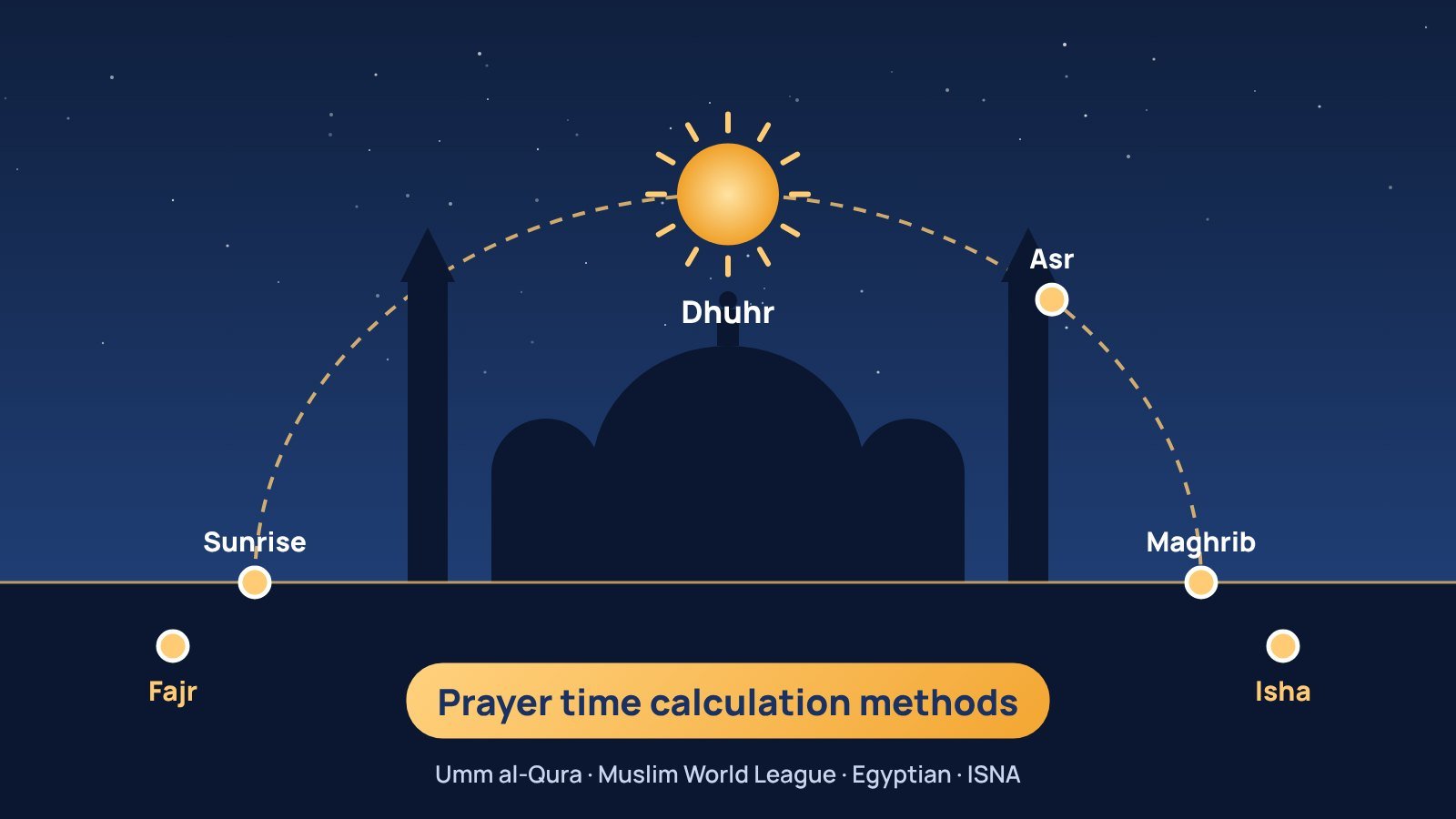
Why Prayer Times Differ Between Apps: Calculation Methods and Umm al-Qura Explained
Two apps, two different Fajr times? Here is how prayer times are calculated, why Fajr and Isha depend on the method you choose, how Umm al-Qura works, and which method to pick, with real examples.
Have you noticed that two prayer apps on your phone give different Fajr times for the same city? The gap can be 15 minutes or more, and usually neither app is wrong: each uses a different calculation method. Dhuhr and Maghrib are almost identical in every method, but Fajr and Isha depend on how far the sun is below the horizon, and astronomical and religious bodies chose different angles for that.
This guide explains how the five prayer times are calculated, how Umm al-Qura differs from the Muslim World League, Egyptian and ISNA methods, why Asr is later in the Hanafi school, and what happens in northern cities in summer. You can compare methods yourself with the Prayer Times tool below: pick a city, change the method and watch the times move.
Prayer Times
Open the full toolMakkah, Saudi Arabia
Calculating…
Next prayer
—
--:--:--
Times shown in Asia/Riyadh
Fajr 18.5°, Isha 90 min after Maghrib (120 in Ramadan)
How Are Prayer Times Calculated?
Every prayer time is tied to the sun's position, so the times are calculated astronomically from three inputs: the city's latitude and longitude, the date, and the time zone. From these, the sun's declination and the equation of time give the moment of each prayer:
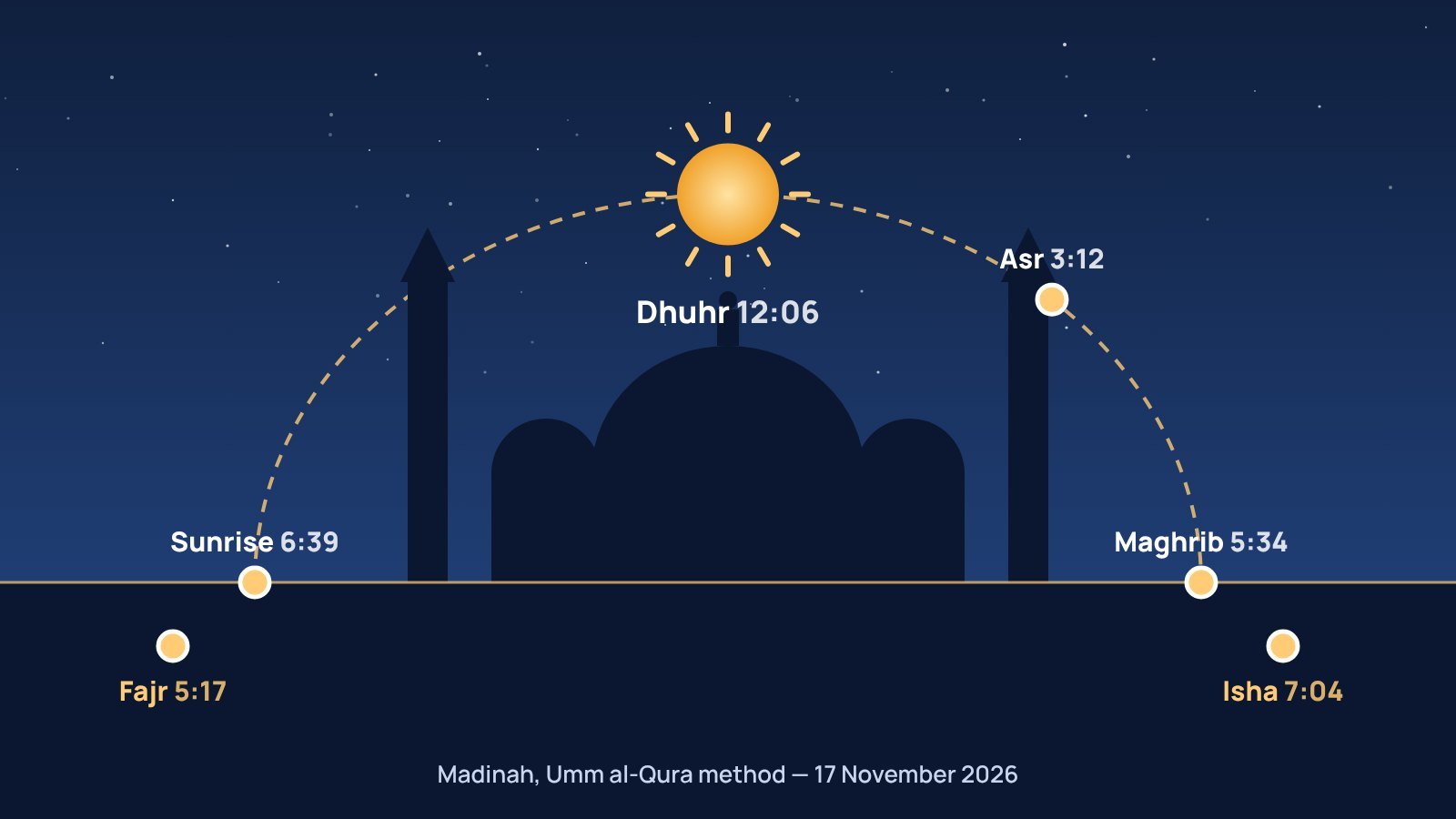
| Prayer | When it begins | Differs between methods? |
|---|---|---|
| Fajr | True dawn, when the sun is a set angle below the horizon (15° to 19.5° depending on the method) | Yes, the biggest difference |
| Sunrise | The top edge of the sun appears above the horizon | No (a minute or two at most) |
| Dhuhr | Just after the sun passes its highest point (solar noon) | Hardly |
| Asr | When an object's shadow equals its length (majority) or twice its length (Hanafi), plus the noon shadow | Depends on the school |
| Maghrib | The whole disc of the sun has set | Hardly |
| Isha | Red twilight has disappeared: an angle below the horizon (14° to 18°) or a fixed time after Maghrib | Yes |
Why don't Dhuhr and Maghrib differ?
The Fajr and Isha Angle: Where the Difference Comes From
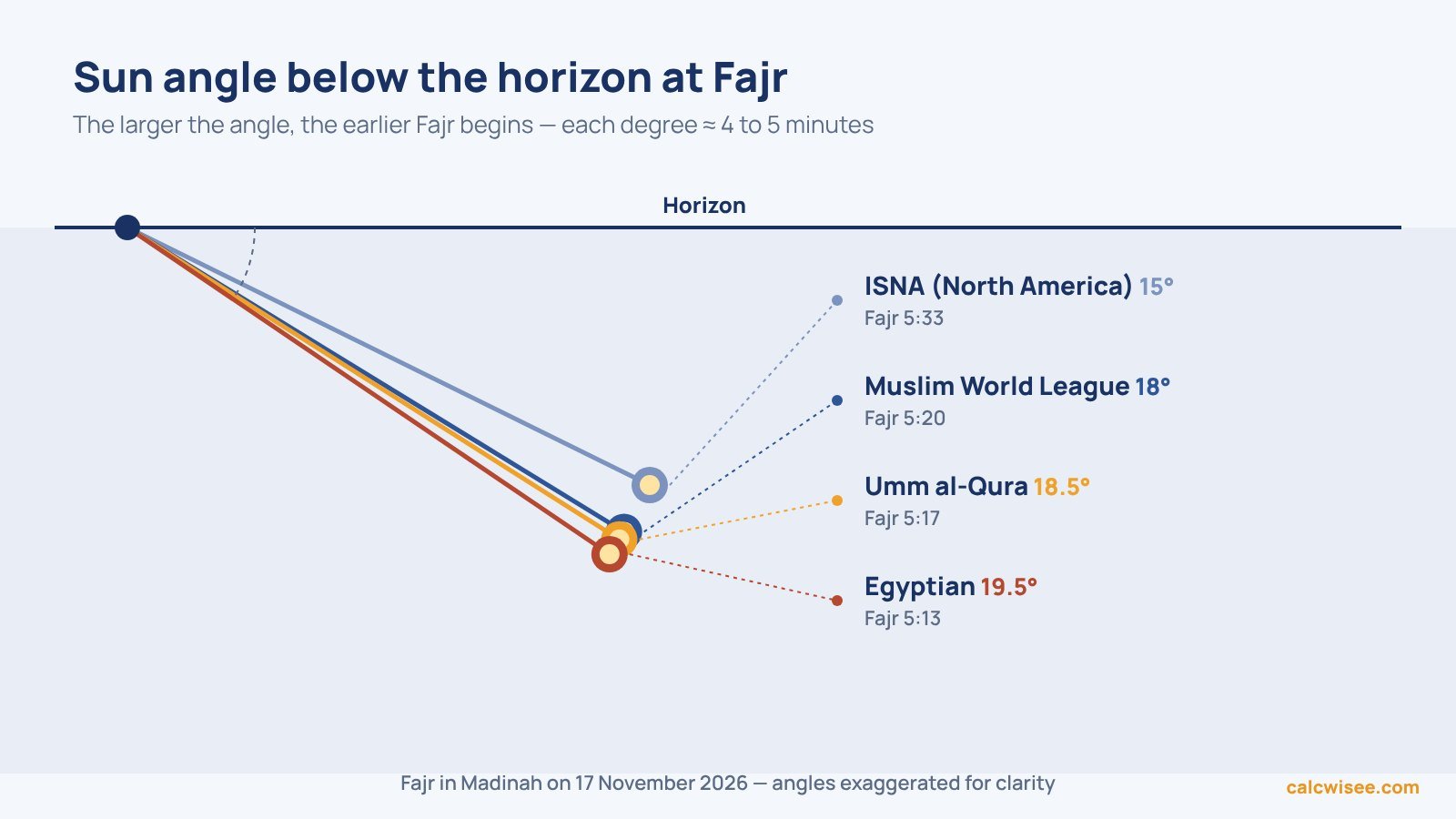
At dawn the sun is below the horizon, and the sky brightens as it rises toward it. A method using 18.5° (Umm al-Qura) starts Fajr while the sun is deeper below the horizon, so earlier than a method using 15° (ISNA). Each degree is worth about 4 to 5 minutes near the tropics, and more in northern countries.
Common Calculation Methods and Their Angles
| Method | Fajr angle | Isha | Used in |
|---|---|---|---|
| Umm al-Qura | 18.5° | 90 min after Maghrib (120 in Ramadan) | Saudi Arabia |
| Muslim World League | 18° | 17° | Europe and many apps |
| Egyptian General Authority of Survey | 19.5° | 17.5° | Egypt, parts of Africa and the Levant |
| University of Islamic Sciences, Karachi | 18° | 18° | Pakistan, India, Bangladesh |
| ISNA (North America) | 15° | 15° | United States and Canada |
| Kuwait | 18° | 17.5° | Kuwait |
| Qatar | 18° | 90 min after Maghrib | Qatar |
| Dubai | 18.2° | 18.2° | United Arab Emirates |
| Diyanet (Turkey) | 18° | 17° | Turkey |
| Singapore / Malaysia / Indonesia | 20° | 18° | Southeast Asia |
Some authorities also add precautionary minutes to certain prayers, delaying Dhuhr or Maghrib by one to three minutes, so you may see small differences even in the prayers that no one disputes.
What Is the Umm al-Qura Prayer Method?
Umm al-Qura is the official method in Saudi Arabia, used by mosques and government calendars. It has two features:
- Fajr at 18.5° below the horizon, slightly more than the Muslim World League, so Fajr comes about 2 to 3 minutes earlier.
- Isha at a fixed interval, not an angle: 90 minutes after Maghrib all year, extended to 120 minutes in Ramadan to make Taraweeh easier.
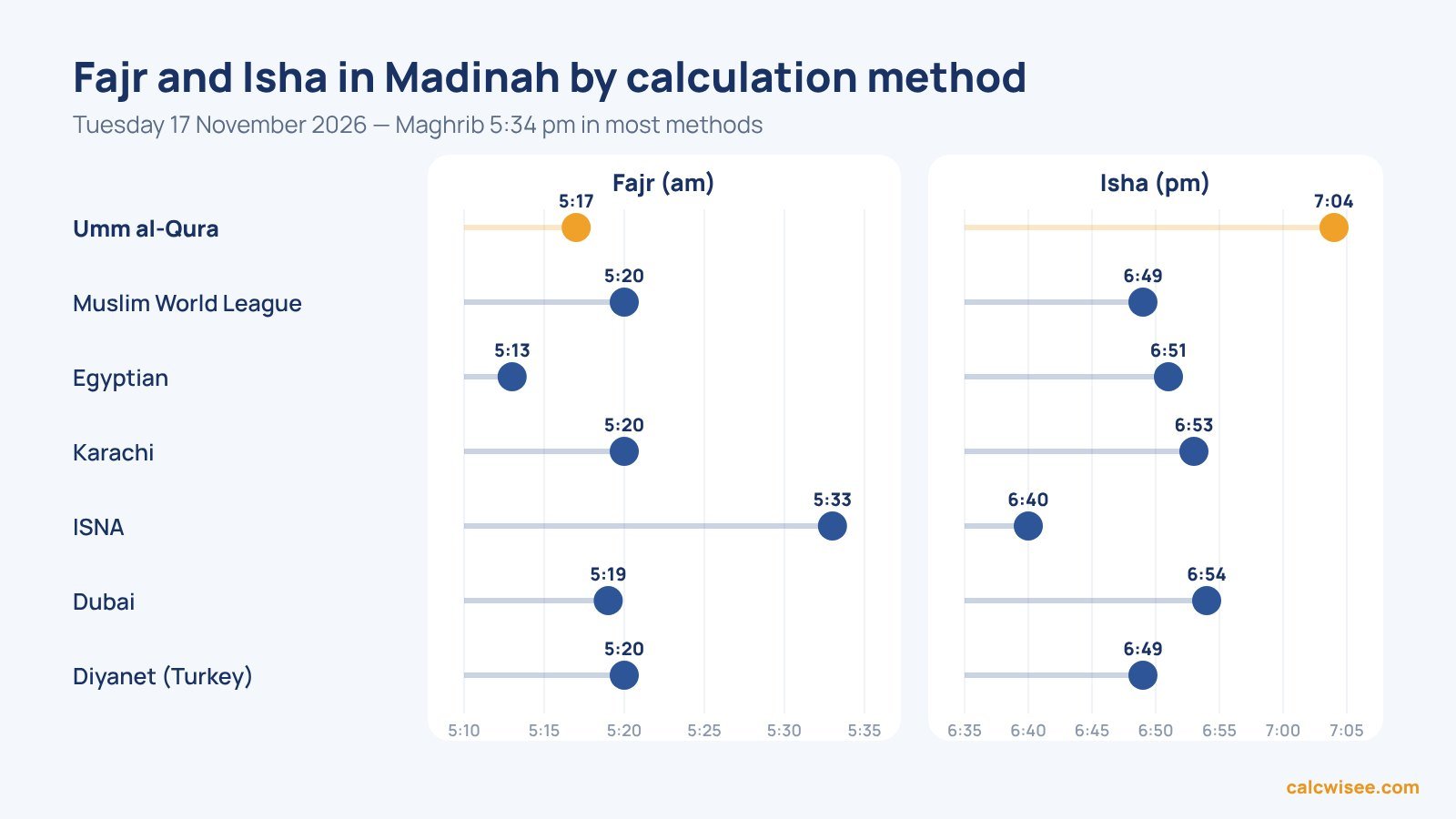
That is why Isha in Saudi Arabia is a little later than angle-based methods in winter. In Madinah on 17 November 2026, for example, Maghrib is at 5:34 pm and Isha at 7:04 pm by Umm al-Qura, while the Muslim World League puts Isha at 6:49 pm.
A Real Example: Madinah With Seven Methods
Here are the prayer times for Madinah on Tuesday 17 November 2026 calculated with seven methods (standard Asr):
| Method | Fajr | Sunrise | Dhuhr | Asr | Maghrib | Isha |
|---|---|---|---|---|---|---|
| Umm al-Qura | 5:17 | 6:39 | 12:06 | 3:12 | 5:34 | 7:04 |
| Muslim World League | 5:20 | 6:39 | 12:07 | 3:12 | 5:34 | 6:49 |
| Egyptian | 5:13 | 6:39 | 12:07 | 3:12 | 5:34 | 6:51 |
| Karachi | 5:20 | 6:39 | 12:07 | 3:12 | 5:34 | 6:53 |
| ISNA | 5:33 | 6:39 | 12:07 | 3:12 | 5:34 | 6:40 |
| Dubai | 5:19 | 6:36 | 12:09 | 3:15 | 5:37 | 6:54 |
| Diyanet (Turkey) | 5:20 | 6:32 | 12:11 | 3:16 | 5:41 | 6:49 |
Sunrise, Dhuhr, Asr and Maghrib match in the first five methods; Dubai and Turkey differ slightly because of the precautionary minutes they add. Fajr ranges from 5:13 am (Egyptian, 19.5°) to 5:33 am (ISNA, 15°).
Asr Time: Standard vs Hanafi
Asr begins when shadows lengthen in the afternoon, and there are two views:
- Standard (Shafi'i, Maliki, Hanbali): when an object's shadow equals its length, plus its shadow at noon.
- Hanafi: when an object's shadow is twice its length, plus its shadow at noon.
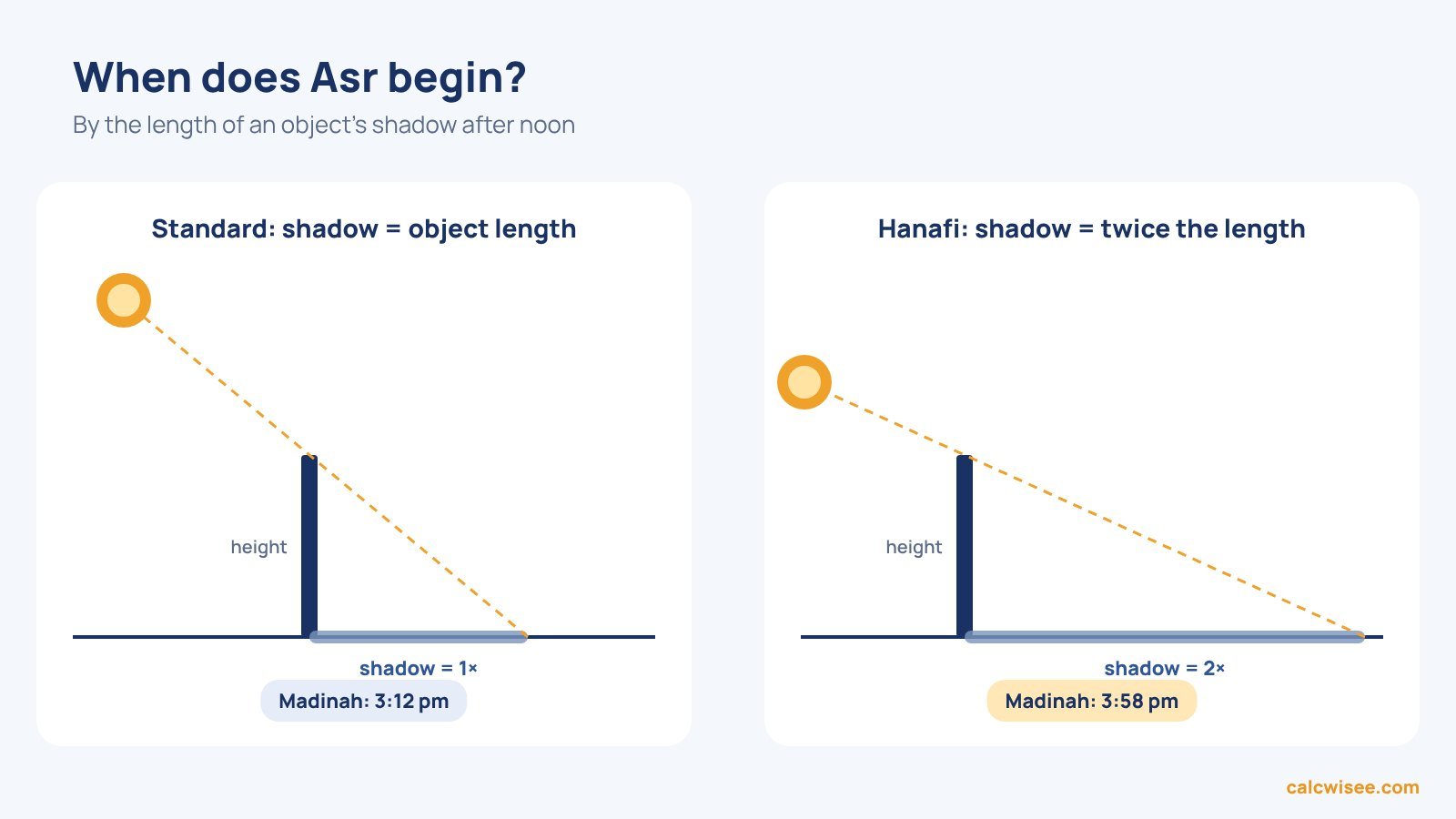
The difference is large: in Madinah on 17 November 2026, Asr begins at 3:12 pm (standard) and 3:58 pm (Hanafi), 46 minutes apart. In Riyadh the same day: 2:44 pm versus 3:30 pm. The prayer times tool lets you choose either.
Prayer Times in Northern Cities in Summer
In cities far from the equator, such as London (51.5° N), the sun never sinks 18° below the horizon on summer nights. Twilight never fully disappears, so Fajr and Isha cannot be calculated with the usual angle. Methods use fallback rules instead:
- One-seventh of the night: the night (Maghrib to sunrise) is split into seven parts; Isha is after the first part and Fajr before the last.
- Middle of the night: Isha and Fajr are placed around the middle of the night.
- Angle-based portion: the share of the night is the method's angle divided by 60.
- Nearest day or nearest city where the normal times exist, which some fiqh councils recommend.
| London | Fajr | Sunrise | Maghrib | Isha |
|---|---|---|---|---|
| 21 June 2026 (Muslim World League) | 3:40 am | 4:43 am | 9:22 pm | 10:25 pm |
| 21 December 2026 (Muslim World League) | 5:59 am | 8:04 am | 3:53 pm | 5:51 pm |
In June there are only about 6 hours between Maghrib and Fajr, and the times come from the one-seventh rule, which is why the Muslim World League and ISNA give the same Fajr (3:40 am). The CalcWisee tool applies this rule automatically in cities above 48° latitude.
Other Reasons Apps Disagree
- Imprecise location: some apps use the city centre; across a large city, sunrise and sunset can differ by a minute or two.
- Elevation: on high ground you see the sun slightly earlier, but most apps ignore elevation.
- Time zone and daylight saving: a wrong phone setting shifts every time by a full hour.
- Precaution and rounding: rounding minutes up instead of to the nearest minute creates a one-minute gap.
- Asr school: choosing Hanafi instead of standard moves Asr 40 minutes or more.
How to Choose the Right Method
- 1In Saudi Arabia: Umm al-Qura.
- 2In another Arab or Muslim country: your country's official method (Egyptian in Egypt, Kuwait, Qatar, Dubai in the UAE).
- 3In Europe: usually the Muslim World League, or whatever your local Islamic centre uses.
- 4In North America: ISNA or your mosque's choice; many mosques there use 18° for Fajr as a precaution.
- 5Then compare the result with your nearest mosque's timetable and keep the method that matches.
Frequently Asked Questions
Why do Fajr times differ between apps?
Each app uses a different sun angle below the horizon: 15° for ISNA, 18° for the Muslim World League, 18.5° for Umm al-Qura and 19.5° for the Egyptian method. Each degree is worth about 4 to 5 minutes.
What is the Umm al-Qura prayer time method?
The official method in Saudi Arabia: Fajr at 18.5° below the horizon, and Isha 90 minutes after Maghrib all year, or 120 minutes in Ramadan.
Which calculation method should I use?
Use the official method in your country or the one your mosque follows: Umm al-Qura in Saudi Arabia, the Egyptian method in Egypt, usually the Muslim World League in Europe and ISNA in North America.
Why is Hanafi Asr later?
Hanafi Asr begins when the shadow is twice the object's length, compared with once in the other schools, so it is about 40 to 60 minutes later depending on place and season.
How long is it between Maghrib and Isha in Saudi Arabia?
90 minutes all year by the Umm al-Qura calendar, and 120 minutes during Ramadan.
How are prayer times calculated in the UK and Scandinavia in summer?
When the sun does not reach the Fajr and Isha angle, methods use fallback rules such as one-seventh of the night, the middle of the night, or the nearest day or city where the normal times exist.
Does elevation affect prayer times?
Slightly, mainly sunrise and Maghrib, but most timetables and apps calculate at sea level.
Sources
- Umm al-Qura calendar — official site
- adhan-js prayer time library (the library the CalcWisee tool uses)
- PrayTimes.org — calculation methods
- Times in the tables are calculated for city centres at sea level and can differ by a minute or two from mosque timetables.