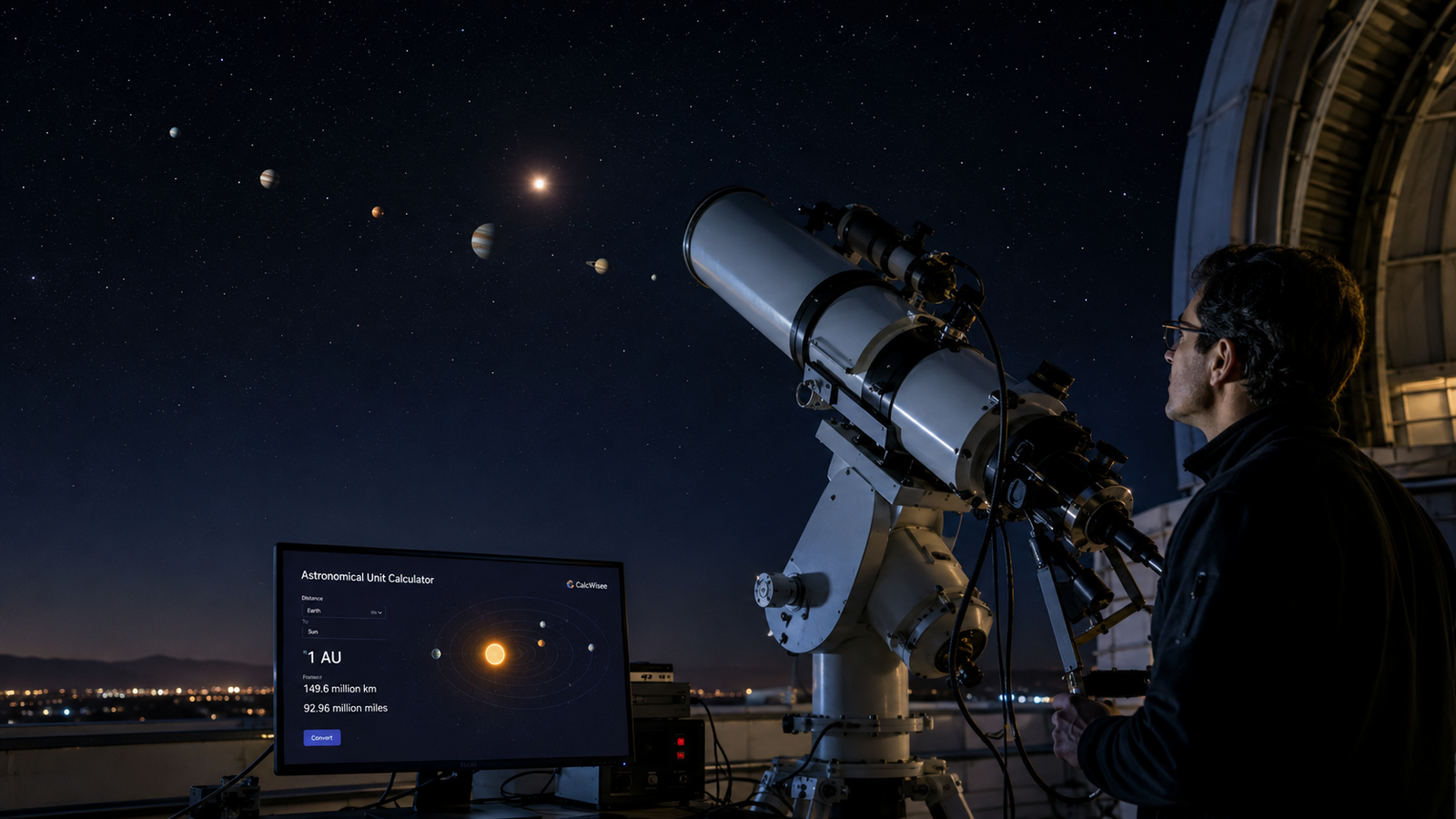
Astronomical Unit Calculator: Understanding Distances in Space
Understand the astronomical unit (AU), convert AU to kilometres and miles with the IAU exact value, and explore Solar System distances with a free calculator.
Space is unimaginably large. The distance between Earth and the Sun is far greater than the distances we normally use in everyday life, making kilometres or miles inconvenient for describing many astronomical distances.
Astronomers therefore use specialized units to make distances within our Solar System easier to understand and compare. One of the most important is the **Astronomical Unit (AU)**.
The Astronomical Unit Calculator helps you convert astronomical units into kilometres, miles, metres, light-travel time, light-years, or parsecs and understand what these measurements mean in real astronomical terms.
In this guide, you will learn what an astronomical unit is, how large one AU is, how to convert AU to kilometres and miles, how the unit is used in astronomy, and how to calculate distances between objects in the Solar System.
Try it right here — results update instantly.
1.000000 Astronomical Units (AU) = 149597870.700000 Kilometres (km)
| Unit | Equivalent |
|---|---|
| Astronomical Units (AU) | 1.000000 |
| Kilometres (km) | 149597870.700000 |
| Miles (mi) | 92955807.273026 |
| Metres (m) | 149597870700.000000 |
| Light-minutes | 8.316746 |
| Light-hours | 0.138612 |
| Light-years (Julian) | 0.000016 |
| Parsecs (pc) | 0.000005 |
Base definition: 1 AU = 149,597,870,700 m exactly (IAU 2012) = 149,597,870.7 km = ≈ 92,955,807.3 miles.
What Is an Astronomical Unit?
An **astronomical unit (AU or au)** is a unit of length used primarily to express distances within the Solar System. By definition of the International Astronomical Union (IAU), one astronomical unit equals exactly **149,597,870,700 metres**.
That fixed length is essentially the scale of the mean Earth–Sun distance. Saying “Mars orbits near 1.5 AU” is far clearer than quoting hundreds of millions of kilometres every time.
Historically the AU was refined from planetary observations and radar ranging. In 2012 the IAU adopted an exact metre-based definition so every textbook, ephemeris, and calculator can share the same constant without re-deriving the Earth–Sun average each year.
How Large Is One Astronomical Unit?
Using the IAU definition and standard SI / imperial factors:
- **1 AU = 149,597,870,700 m** (exact)
- **1 AU = 149,597,870.7 km** (exact)
- **1 AU ≈ 92,955,807.3 miles** (international mile)
- **1 AU ≈ 8.317 light-minutes** (time for light to cross 1 AU in vacuum)
- **1 AU ≈ 1.58125 × 10⁻⁵ Julian light-years**
Classroom materials sometimes round this to “about 150 million km” or “93 million miles.” Those shortcuts are fine for intuition, but homework, lab reports, and the Astronomical Unit Calculator use the exact IAU figure.
AU Conversion Table
Quick reference values derived from 1 AU = 149,597,870,700 m:
| From | To | Multiply by |
|---|---|---|
| 1 AU | metres (m) | 149,597,870,700 |
| 1 AU | kilometres (km) | 149,597,870.7 |
| 1 AU | miles (mi) | ≈ 92,955,807.3 |
| 1 km | AU | ≈ 6.684587122 × 10⁻⁹ |
| 1 mile | AU | ≈ 1.075780156 × 10⁻⁸ |
| 1 AU | light-minutes | ≈ 8.3167 |
| 1 AU | Julian light-years | ≈ 1.58125 × 10⁻⁵ |
How to Convert Astronomical Units
AU to kilometres
**kilometres = AU × 149,597,870.7**
Example: 5.2 AU × 149,597,870.7 ≈ 777,908,927.6 km (about Jupiter’s average heliocentric distance).
AU to miles
**miles = AU × (149,597,870,700 ÷ 1,609.344)** ≈ **AU × 92,955,807.3**
Example: 1 AU ≈ 92,955,807.3 miles.
Kilometres or miles to AU
**AU = kilometres ÷ 149,597,870.7**
**AU = miles ÷ 92,955,807.3** (approx., international mile)
Example: 227,900,000 km ÷ 149,597,870.7 ≈ 1.52 AU (a typical Mars semi-major axis scale).
You can check multi-step arithmetic with the Scientific Calculator and confirm unit chains with the Unit Converter.
Typical Solar System Distances in AU
Average (approximate) heliocentric distances commonly cited in educational materials:
| Object | Approx. distance from Sun (AU) | Approx. km |
|---|---|---|
| Mercury | 0.39 | ≈ 58 million |
| Venus | 0.72 | ≈ 108 million |
| Earth | 1.00 | 149,597,870.7 |
| Mars | 1.52 | ≈ 228 million |
| Jupiter | 5.20 | ≈ 778 million |
| Saturn | 9.58 | ≈ 1.43 billion |
| Uranus | 19.2 | ≈ 2.87 billion |
| Neptune | 30.1 | ≈ 4.50 billion |
Orbits are ellipses, so real distances change continuously. NASA mission pages and ephemerides give time-specific ranges; the AU still remains the natural unit for quoting those ranges. See NASA Solar System Exploration for planet fact sheets.
Why Astronomers Use the AU
- **Readable scale** — “30 AU” is easier than “4.5 billion km.”
- **Orbit comparisons** — Keplerian periods and semi-major axes are naturally expressed in AU and years.
- **Spacecraft communication** — light-time delay scales with AU (about 8.3 minutes per AU one-way).
- **Education** — scale models of the Solar System map cleanly when 1 AU is the classroom baseline.
- **Consistency** — an exact metre definition aligns astronomy with SI metrology (NIST constants).
AU vs Light-Year vs Parsec
| Unit | Typical use | Rough size |
|---|---|---|
| Astronomical unit (AU) | Solar System orbits, spacecraft ranges | ≈ 1.496 × 10⁸ km |
| Light-year (ly) | Nearby stars and the Milky Way | ≈ 9.461 × 10¹² km ≈ 63,241 AU |
| Parsec (pc) | Stellar parallax and galactic scales | ≈ 3.086 × 10¹³ km ≈ 206,265 AU |
Use AU inside the Solar System. Switch to light-years or parsecs for stellar and galactic work. CalcWisee’s Light Year Converter and the Astronomical Unit Calculator cover both directions.
How to Use the Astronomical Unit Calculator
- Open the Astronomical Unit Calculator.
- Select the unit you already know (AU, km, miles, metres, light-time, light-years, or parsecs).
- Enter the value — decimals and scientific notation such as `1.52` or `3e1` are supported.
- Choose the target unit and read the live result plus the full equivalence table.
- Use Convert to keep a short history, Swap to reverse direction, or Reset for a new problem.
Clear validation messages appear if the field is empty, negative, or not a finite number, so classroom and homework use stays straightforward.
Worked Examples
Example 1 — Earth
Input: 1 AU → Output: 149,597,870.7 km and ≈ 92,955,807.3 miles. Light travel time ≈ 8.32 minutes.
Example 2 — Mars
Input: 1.52 AU → ≈ 227.4 million km. Useful when comparing Earth–Mars transfer distances in educational models.
Example 3 — Kilometres back to AU
Input: 778,000,000 km → ≈ 5.20 AU, matching Jupiter’s approximate average distance.
Common Mistakes to Avoid
- Treating the AU as a unit of **time** (it is a length).
- Using “150 million km” when an assignment expects the exact IAU value.
- Mixing **statute miles** with **nautical miles** after converting from AU.
- Chaining many rounded conversions instead of converting once from the AU definition.
- Applying AU to stellar distances where light-years or parsecs are clearer.
Frequently Asked Questions
What is an astronomical unit?
An astronomical unit (AU) is a length equal to exactly 149,597,870,700 metres as defined by the IAU in 2012. It is the standard scale for distances within the Solar System and roughly matches the mean Earth–Sun distance.
How many kilometres are in 1 AU?
Exactly 149,597,870.7 kilometres, because 1 AU = 149,597,870,700 metres by definition.
How many miles are in 1 AU?
About 92,955,807.3 international miles, using 1 mile = 1,609.344 metres.
Is the AU the exact Earth–Sun distance every day?
No. Earth’s orbit is slightly elliptical, so the instantaneous Earth–Sun distance varies around 1 AU. The AU itself is a fixed defined length.
Can the calculator handle decimals and large values?
Yes. Enter values such as 0.39, 5.2, or 1.5e3. Results can be shown in standard, scientific, or engineering notation.
When should I use light-years instead of AU?
Use light-years (or parsecs) for stellar and galactic distances. Keep AU for planets, comets, and spacecraft ranges inside the Solar System.
Is the calculator free?
Yes. The Astronomical Unit Calculator on CalcWisee is free, runs in your browser, and does not require an account for core conversions.
Where can I verify the official definition?
See the International Astronomical Union (IAU) for the AU definition, NASA for Solar System context, and NIST for related physical constants and unit guidance.
Related CalcWisee Tools
- Astronomical Unit Calculator — convert AU, km, miles, light-time, light-years, and parsecs
- Unit Converter — everyday metric and imperial conversions
- Length Converter — metres, feet, miles, and more
- Scientific Calculator — advanced arithmetic for science problems
- Light Year Converter — stellar distance units
- All Calculators — browse the full CalcWisee directory
- Astronomy Calculators — astronomy category hub
References and Further Reading
- International Astronomical Union (IAU) — official AU definition and astronomy standards
- NASA — Solar System Exploration — planet distances and mission context
- NIST — Constants, Units & Uncertainty — physical constants and unit guidance
- BIPM — SI Brochure — International System of Units
Accuracy Note
Conversions on this page use the exact IAU metre definition of the astronomical unit and standard SI/imperial factors. Educational tables of planetary distances are approximate averages. For navigation, mission design, or legal metrology, rely on official ephemerides and standards bodies. CalcWisee does not claim external PageSpeed scores or live search-index status for this page without independent testing.
Conclusion
The astronomical unit turns the vast Earth–Sun scale into a single, exact length: **149,597,870.7 km**. With that constant you can convert textbook AU figures into kilometres or miles, compare planetary orbits, and estimate light-travel time across the Solar System.
Put the formulas into practice with the free Astronomical Unit Calculator, explore everyday units in the Unit Converter, and browse more tools on All Calculators.
Try it yourself
Put this guide into practice with our free tool.
CalcWisee Editorial Team
Calculator development and formula review
CalcWisee is an independent site founded by Ayman. Every calculator is built from a published formula or official definition, tested against hand-worked examples before it goes live, and corrected promptly when a reader reports an issue to ayman@calcwisee.com.
Expertise: Financial mathematics, Health and fitness formulas, Applied mathematics, Unit conversion standards