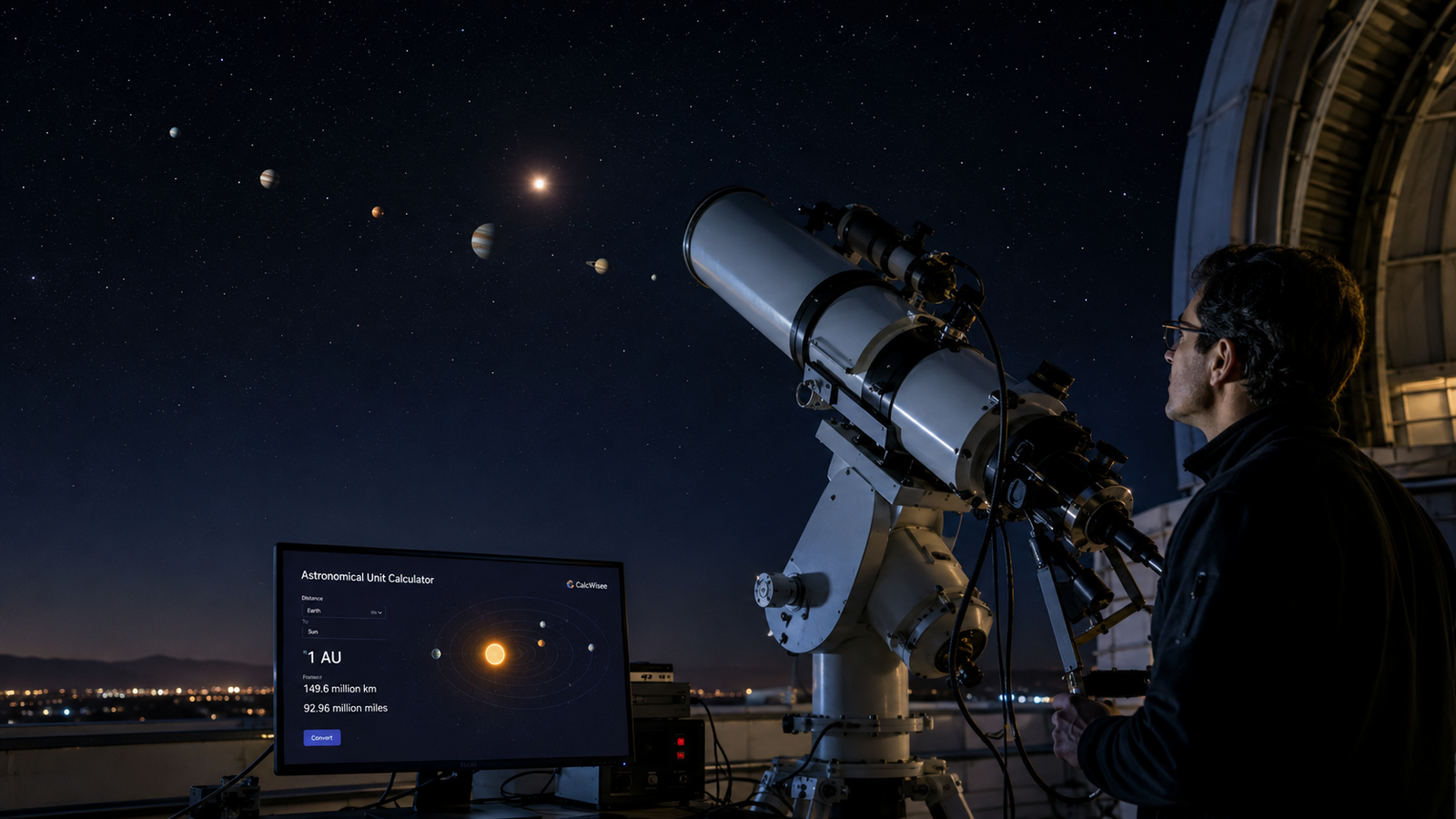
Astronomical Unit Calculator
Convert astronomical units (AU) to kilometres, miles, metres, light-minutes, light-hours, light-years, and parsecs using the IAU 2012 exact definition of 1 AU = 149,597,870.7 km.
Reviewed October 7, 2026 Runs in your browser — inputs are never stored
1.000000 Astronomical Units (AU) = 149597870.700000 Kilometres (km)
| Unit | Equivalent |
|---|---|
| Astronomical Units (AU) | 1.000000 |
| Kilometres (km) | 149597870.700000 |
| Miles (mi) | 92955807.273026 |
| Metres (m) | 149597870700.000000 |
| Light-minutes | 8.316746 |
| Light-hours | 0.138612 |
| Light-years (Julian) | 0.000016 |
| Parsecs (pc) | 0.000005 |
Base definition: 1 AU = 149,597,870,700 m exactly (IAU 2012) = 149,597,870.7 km = ≈ 92,955,807.3 miles.
This tool provides educational conversions of astronomical distances only. It is not a navigation, mission-planning, or ephemeris service. For professional or spacecraft work, use official IAU, NASA, or observatory data products.
About the Astronomical Unit Calculator
The Astronomical Unit Calculator on CalcWisee converts Solar System distances between astronomical units and everyday length units. One astronomical unit (AU) is defined by the International Astronomical Union as exactly 149,597,870,700 metres — equal to 149,597,870.7 kilometres or about 92.96 million miles — roughly the mean Earth–Sun distance. Enter a value in AU, km, miles, metres, light-time, light-years, or parsecs, choose the target unit, and read the full equivalence table. The tool accepts decimals and scientific notation (for example 0.39 or 1.5e3), shows clear validation messages for empty or invalid input, and runs entirely in your browser. Students, educators, amateur astronomers, and writers use it to compare planetary orbits, spacecraft ranges, and textbook figures without manual unit juggling. Pair it with the Unit Converter and Length Converter for terrestrial units, or the Scientific Calculator for related arithmetic. Results are educational estimates based on published IAU and NIST constants — not a substitute for mission ephemerides when precision-critical navigation is required.
How to use it
- 1Choose the unit you already have (for example Astronomical Units or Kilometres).
- 2Enter the distance — decimals and scientific notation such as 5.2 or 1.5e2 are supported.
- 3Select the target unit (km, miles, metres, light-minutes, light-hours, light-years, or parsecs).
- 4Press Convert to lock the result in history, or read the live result and full equivalence table.
- 5Use Swap to reverse direction, adjust decimal places or scientific notation, then Reset for a new scenario.
Worked example
Earth–Sun distance of 1 AU converts to exactly 149,597,870.7 km and about 92,955,807.3 miles. Mars at roughly 1.52 AU is about 227.4 million km. Jupiter near 5.2 AU is about 777.9 million km. Light takes about 8.32 minutes to travel 1 AU, so a 5.2 AU path is roughly 43 light-minutes — useful when comparing radio delay to outer planets.
How it works
What is an Astronomical Unit?
The astronomical unit (symbol au or AU) is a unit of length defined as exactly 149,597,870,700 metres by the International Astronomical Union (IAU) in 2012. It is approximately the mean Earth–Sun distance and is the standard scale for orbits inside the Solar System.
Key reference values
- 1 AU = 149,597,870,700 m (exact)
- 1 AU = 149,597,870.7 km (exact)
- 1 AU ≈ 92,955,807.3 miles
- 1 AU ≈ 8.317 light-minutes
- 1 AU ≈ 1.58125 × 10⁻⁵ Julian light-years
Formula
kilometres = AU × 149,597,870.7 · miles = AU × (149,597,870,700 ÷ 1,609.344) · AU = kilometres ÷ 149,597,870.7
Tips for better results
- Prefer AU for Solar System scales and light-years or parsecs for stellar distances.
- Keep one consistent source unit when comparing several planets side by side.
- Use scientific notation for very large kilometre totals to avoid reading errors.
- Remember 1 AU is fixed by definition; actual Earth–Sun distance varies slightly over the year.
Common mistakes to avoid
- Treating AU as a time unit instead of a length unit.
- Mixing statute miles with nautical miles when converting from AU.
- Rounding intermediate AU values too early when chaining several conversions.
- Using approximate “150 million km” in precision work instead of 149,597,870.7 km.
Frequently asked questions
A:By the IAU 2012 definition, 1 astronomical unit equals exactly 149,597,870.7 kilometres (149,597,870,700 metres).
A:Using the international mile (1,609.344 m), 1 AU is approximately 92,955,807.3 miles.
A:It provides a convenient Solar System scale — for example Neptune orbits near 30 AU — so distances are far easier to compare than raw kilometre counts.
A:The AU is not an SI base unit, but it is accepted for use with the SI and is defined exactly in metres by the IAU.
Reviewed for accuracy · Last updated October 7, 2026
The astronomical unit is taken as exactly 149,597,870,700 metres per the IAU 2012 definition. Related light-time and light-year factors use the defined speed of light and the IAU Julian year where applicable.
CalcWisee Editorial Team
Calculator development and formula review
CalcWisee is an independent site founded by Ayman. Every calculator is built from a published formula or official definition, tested against hand-worked examples before it goes live, and corrected promptly when a reader reports an issue to ayman@calcwisee.com.
Expertise: Financial mathematics, Health and fitness formulas, Applied mathematics, Unit conversion standards
References & sources