Time Calculator
Add, subtract, and convert hours, minutes, and seconds — or find the difference between two clock times, including overnight spans that cross midnight.
Reviewed October 7, 2026 Runs in your browser — inputs are never stored
Add hours, minutes, and seconds
Result
4h 15m
2h 45m + 1h 30m = 4h 15m
Formula: Total seconds = Σ (h×3600 + m×60 + s), then normalize
Sum all durations in seconds, then carry into hours, minutes, and seconds
- A: 2h 45m 0s = 9900 seconds
- B: 1h 30m 0s = 5400 seconds
- Sum: 9900 + 5400 = 15300 seconds
- Normalize → 4h 15m
- Hours
- 4
- Minutes
- 15
- Seconds
- 0
- Total minutes
- 255
- Total seconds
- 15300
- Decimal hours
- 4.25
Quick reference — hours to minutes
| Hours | Minutes | Seconds |
|---|---|---|
| 30 min | 1,800 s | |
| 60 min | 3,600 s | |
| 90 min | 5,400 s | |
| 120 min | 7,200 s | |
| 180 min | 10,800 s | |
| 300 min | 18,000 s | |
| 1,440 min | 86,400 s |
Quick examples — add & subtract
Learn more about time calculations — read our Time Calculator guide with formulas, midnight crossing, decimal hours, and workplace examples.
This tool performs standard mathematical operations for educational and reference purposes. Always double-check results for critical academic or professional work.
About the Time Calculator
A time calculator is a versatile tool for adding, subtracting, and converting durations expressed in hours, minutes, and seconds. It is built for anyone who works with time-based data — project managers tracking task durations, freelancers logging billable hours, runners and cyclists analysing splits, event planners scheduling programmes, and students solving physics or payroll problems. You can add multiple durations together, subtract one from another, find the elapsed time between two clock times (including spans that cross midnight), or convert decimal hours into a clean hours-and-minutes format. The calculator normalises every result automatically, carrying seconds into minutes and minutes into hours, and shows the working steps so you can verify the answer. It supports both 12-hour and 24-hour clock formats, making it equally useful for international scheduling and everyday planning. By removing the manual arithmetic that so often leads to errors in timesheets and rotas, this tool saves time and improves accuracy for anyone who manages or measures time.
How to use it
- 1Enter times in hours, minutes, and seconds as labeled.
- 2Choose add, subtract, or duration between timestamps if available.
- 3Calculate the total or difference.
- 4Convert the result to decimal hours when billing or payroll needs it.
- 5Watch for day rollovers on clock arithmetic past midnight.
Worked example
2h 45m + 1h 40m = 4h 25m. From 09:15 to 17:00 is 7h 45m (7.75 decimal hours). Payroll errors often come from treating 1.5 hours as 1h 50m — decimal hours and sexagesimal minutes are different systems.
Who it is for
Freelancers and contractors logging billable hours, project managers totalling task durations, runners and cyclists analysing splits, event planners scheduling programmes, and students solving physics or payroll time problems.
Why it helps
Adding and subtracting base-60 time values by hand is error-prone — minutes don't carry at 100. The calculator normalises seconds, minutes, and hours automatically and handles midnight crossings that are easy to miss manually.
Tips for better results
- For timesheets, use "Add Time" to sum several durations, then convert the total to decimal hours for billing with "Convert Time".
- When a shift crosses midnight (e.g. 11 PM → 2 AM), use "Time Difference" — it adds 24 hours automatically when end is earlier than start.
- Enter whole numbers for hours, minutes, and seconds; for fractional hours like 1.5, use "Convert Time" instead of the add/subtract fields.
- Keep one unit system per calculation — mixing "2h 30m" entry with a decimal-hours target causes confusion.
Common mistakes to avoid
- Treating minutes as decimal (writing 2.30 for 2 h 30 min) — 30 minutes is 0.5 hours, not 0.30.
- Forgetting that a shift ending before it started crosses midnight, so the raw subtraction gives a negative number.
- Subtracting a longer duration from a shorter one in "Subtract Time" without swapping the order first.
- Rounding each split separately before adding, which compounds small errors into a noticeable total.
Frequently asked questions
A:Add seconds, then minutes (carry every 60 minutes as 1 hour), then hours. Example: 2h 45m + 1h 30m = 4h 15m.
A:If the end time is earlier than the start time, add 24 hours to the end. Example: 11:00 PM to 2:00 AM = 3 hours.
A:Multiply the decimal portion by 60. Example: 1.5 hours = 1 hour + 0.5×60 = 1 hour 30 minutes.
A:1 hour = 60 minutes = 3,600 seconds.
A:Yes. In Time Difference mode you can switch between 12-hour (AM/PM) and 24-hour clock formats.
Reviewed for accuracy · Last updated October 7, 2026
Calculations use standard, well-established mathematical identities and algorithms with no approximation beyond normal floating-point precision.
CalcWisee Editorial Team
Calculator development and formula review
CalcWisee is an independent site founded by Ayman. Every calculator is built from a published formula or official definition, tested against hand-worked examples before it goes live, and corrected promptly when a reader reports an issue to ayman@calcwisee.com.
Expertise: Financial mathematics, Health and fitness formulas, Applied mathematics, Unit conversion standards
References & sources
Related guides
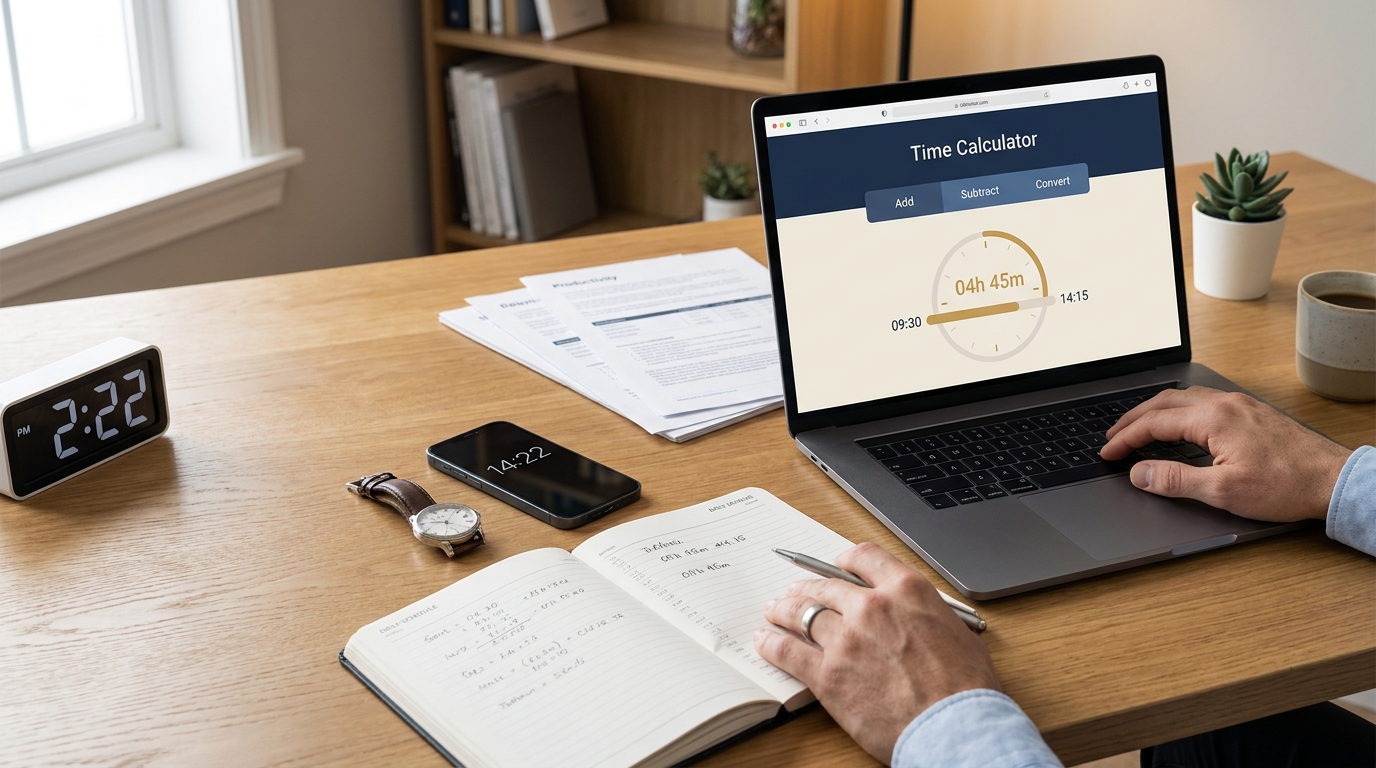
Time Calculator: Add, Subtract and Convert Time
Add and subtract hours, minutes, and seconds, find the difference between two clock times (including overnight), and convert decimal hours — with clear formulas and a free calculator.
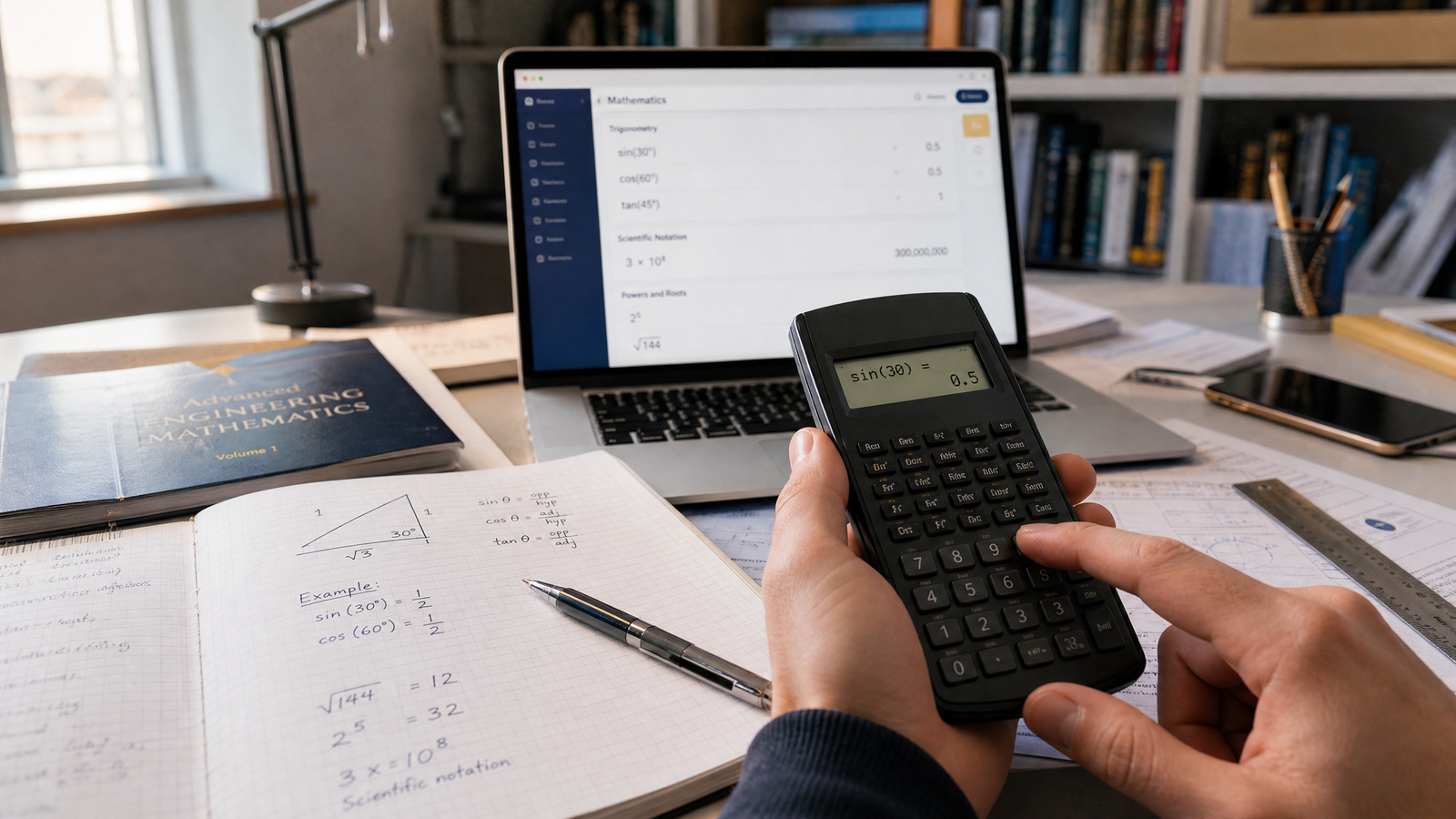
Scientific Calculator Guide: Features, Functions & Tips
Master scientific calculator functions — trigonometry, logarithms, powers, roots, factorials, π, e, and scientific notation — with clear examples and a free online tool.

Unit Converter: The Ultimate Guide to Everyday Conversions
Master everyday metric and imperial conversions — length, mass, temperature, area, volume, speed, time, pressure, energy, and power — with clear formulas and a free multi-category Unit Converter.