Percentage Calculator
Calculate percentages instantly — find X% of a number, reverse percentages, percentage increase and decrease, and percentage difference with clear formulas and steps.
Reviewed October 7, 2026 Runs in your browser — inputs are never stored
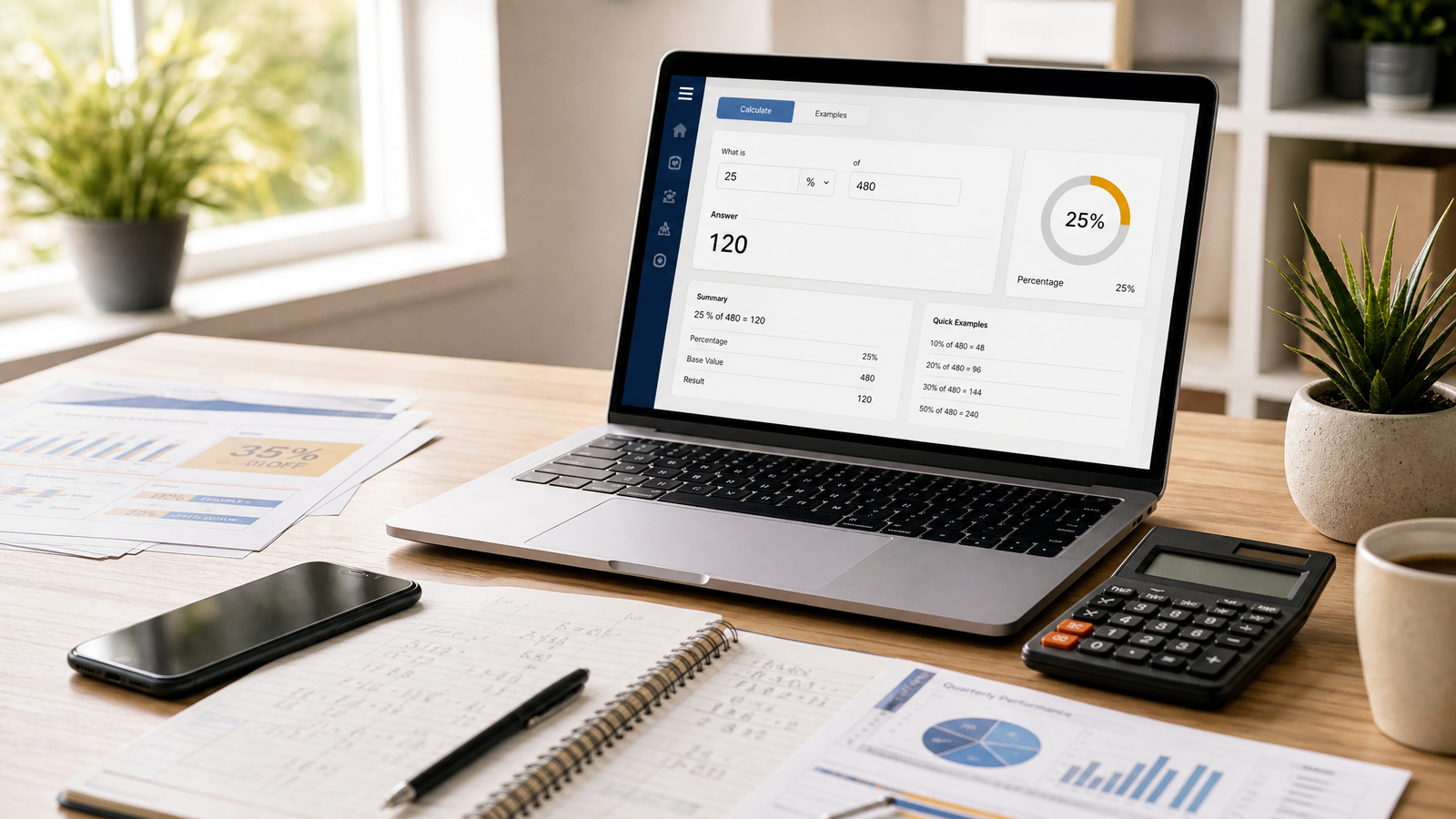
What is X% of Y?
Answer
120
25% of 480 = 120
Formula: Result = Y × (X ÷ 100)
Multiply the base value by the percent divided by 100
- Convert percent to decimal: 25 ÷ 100 = 0.25
- Multiply by the base: 480 × 0.25 = 120
- Mode
- X% of Y
- Percentage (X)
- 25%
- Of number (Y)
- 480
- Result
- 120
Quick examples — What is X% of Y?
Learn more about percentage calculations — read our Percentage Calculator guide with formulas, discounts, tips, tax examples, and FAQs.
This tool performs standard mathematical operations for educational and reference purposes. Always double-check results for critical academic or professional work.
About the Percentage Calculator
A percentage calculator is a practical tool that solves the everyday percentage problems people encounter in shopping, finance, business, and education. Instead of memorising formulas or risking mental-math errors, you can instantly find a percent of a number, work out what percent one value is of another, calculate percentage increase or decrease, or add and subtract a percentage from a base value. This makes it useful for shoppers calculating discounts and sale prices, students verifying homework, marketers measuring growth, and business owners pricing products with tax or markup. The calculator shows the formula and a step-by-step breakdown for every result, so it is as educational as it is convenient. Whether you are splitting a tip, comparing two offers, analysing year-on-year change, or adjusting a recipe, the tool handles decimals and negative values with equal ease. Everything runs locally in your browser, delivering private, instant, and accurate answers for any percentage scenario you encounter.
How to use it
- 1Choose the mode: what is X% of Y, X is what % of Y, or % change.
- 2Enter the base value and the percentage or second value.
- 3Calculate to see the result and plain-language interpretation.
- 4For discounts, apply percentage off the original price carefully.
- 5Chain multiple % changes only when you intend compound effects.
Worked example
18% of 250 = 45. “45 is what percent of 250?” → 18%. A price rising from $80 to $100 is a 25% increase; falling back to $80 is a 20% decrease — percent up and down are not symmetric on the same base.
Who it is for
Shoppers working out discounts and sale prices, students verifying percentage homework, business owners pricing markups and tax, and anyone comparing two values or measuring growth and change.
Why it helps
Percentage maths is easy to get wrong by hand — mixing up the base, forgetting to divide by 100, or confusing increase with difference. The tool applies the correct formula for each mode and shows the working so you can trust the answer.
Tips for better results
- For a discount, use "Add / subtract %" with the original price and the discount rate, choosing subtract — the result is the sale price.
- When measuring change, always put the original (older) value first and the new value second so the sign comes out correctly.
- Use "% Difference" (not "% Increase") when neither value is clearly the baseline — it compares both symmetrically against their average.
- Round only the final displayed result; let the calculator keep full precision internally to avoid compounding errors.
Common mistakes to avoid
- Confusing percentage increase with percentage difference — increase needs a clear original value; difference treats both values equally.
- Dividing by the wrong base: "X is what % of Y" divides X by Y, not the other way around.
- Adding a percentage to a number that already includes it (e.g. adding 20% VAT to a VAT-inclusive price) instead of removing it.
- Treating a 50% increase followed by a 50% decrease as returning to the original — it actually lands 25% lower.
Frequently asked questions
A:Multiply Y by X ÷ 100. Example: 20% of 150 = 150 × 0.20 = 30.
A:Divide X by Y and multiply by 100. Example: 30 is (30 ÷ 120) × 100 = 25% of 120.
A:[(New − Original) ÷ Original] × 100. From 80 to 100 is a 25% increase.
A:The absolute difference divided by the average of the two values, times 100. It treats both values symmetrically.
A:Yes. Decimals and negatives are supported. Division by zero (or a zero original for change) shows a clear error.
Reviewed for accuracy · Last updated October 7, 2026
Calculations use standard, well-established mathematical identities and algorithms with no approximation beyond normal floating-point precision.
CalcWisee Editorial Team
Calculator development and formula review
CalcWisee is an independent site founded by Ayman. Every calculator is built from a published formula or official definition, tested against hand-worked examples before it goes live, and corrected promptly when a reader reports an issue to ayman@calcwisee.com.
Expertise: Financial mathematics, Health and fitness formulas, Applied mathematics, Unit conversion standards
References & sources
Related guides
How to Calculate Percentages: 4 Everyday Problems
A plain-English guide to the four percentage problems you actually use — tips, discounts, growth, and reverse percentages — with worked examples.
Percentage Calculator: Solve Percentage Problems Easily
Master everyday percentage math — find a percent of a number, reverse percentages, percentage increase and decrease, discounts, tax, and tips — with clear formulas and a free calculator.

Time Calculator: Add, Subtract and Convert Time
Add and subtract hours, minutes, and seconds, find the difference between two clock times (including overnight), and convert decimal hours — with clear formulas and a free calculator.