Unit Converter: The Ultimate Guide to Everyday Conversions
Master everyday metric and imperial conversions — length, mass, temperature, area, volume, speed, time, pressure, energy, and power — with clear formulas and a free multi-category Unit Converter.
Whether you are following a recipe written in cups, reading a weather forecast in Celsius, or checking a product spec in millimetres, unit conversion is part of daily life. A reliable Unit Converter removes guesswork and keeps metric and imperial systems working together.
Our free Unit Converter covers ten categories — length, weight/mass, temperature, area, volume, time, speed, pressure, energy, and power — with live tables, formulas, and swap/copy/share tools.
Try it right here — results update instantly.
Category
1 Meter = 3.28084 Foot
- Start: 1 m
- To base (metre): 1 × 1 = 1
- To Foot: 1 ÷ 0.3048 = 3.28084 ft
Conversion table — 1 m equals:
| Unit | Symbol | Value |
|---|---|---|
| Millimeter | mm | 1,000 |
| Centimeter | cm | 100 |
| Meterselected | m | 1 |
| Kilometer | km | 0.001 |
| Inch | in | 39.370079 |
| Footselected | ft | 3.28084 |
| Yard | yd | 1.093613 |
| Mile | mi | 0.00062137119 |
Learn more about unit conversions — read our Unit Converter guide with formulas, metric vs imperial tips, and practical examples.
What Is a Unit Converter?
A Unit Converter is a tool that translates a quantity from one measurement unit into another while preserving the same physical amount. Most converters multiply (or divide) by a fixed conversion factor. Temperature is the main exception: Celsius, Fahrenheit, and Kelvin also differ by offset, so they need affine formulas rather than a pure ratio.
Good converters show the factor or formula, handle decimals cleanly, and list all units in the same family so you can cross-check results at a glance.
Why Are Unit Converters Useful?
- Travel and weather — reading °C vs °F forecasts and road distances in km or miles
- Cooking and baking — cups, millilitres, ounces, and grams
- Shopping and DIY — product dimensions, paint coverage, and lumber sizes
- Fitness and health — body weight, running pace, and energy intake
- Science and engineering — SI base units and derived quantities
- International business — specs, shipping weights, and fuel economy
Metric vs. Imperial Units
The metric (SI) system is decimal: prefixes like milli-, centi-, and kilo- scale by powers of ten. The imperial and US customary systems grew from historical trade measures; many factors are now fixed exactly against the metre and kilogram (for example 1 inch = 0.0254 m exactly).
The United States still uses customary units widely for everyday length, volume, and temperature, while most of the world uses metric. Aviation and maritime navigation also keep specialised units such as knots and nautical miles.
| Quantity | Common metric | Common imperial / US |
|---|---|---|
| Length | mm, cm, m, km | in, ft, yd, mi |
| Mass | mg, g, kg | oz, lb |
| Temperature | °C, K | °F |
| Volume | ml, L, m³ | fl oz, cup, pt, qt, gal |
| Speed | m/s, km/h | mph, kn |
Length Conversion
Length conversions use a single base (the metre). Multiply by the factor that takes you into metres, then divide by the factor for the target unit.
- 1 km = 1,000 m
- 1 m = 100 cm = 1,000 mm
- 1 in = 0.0254 m exactly → 2.54 cm
- 1 ft = 12 in = 0.3048 m
- 1 yd = 3 ft = 0.9144 m
- 1 mi = 5,280 ft = 1,609.344 m ≈ 1.609 km
Example: 5 miles → 5 × 1.609344 = 8.04672 km.
Weight and Mass Conversion
In everyday language “weight” often means mass. SI mass is the kilogram; cooking and shipping still use grams, ounces, and pounds.
- 1 kg = 1,000 g = 1,000,000 mg
- 1 lb = 0.45359237 kg exactly (avoirdupois)
- 1 oz = 1/16 lb ≈ 28.3495 g
Example: 150 lb → 150 × 0.45359237 ≈ 68.04 kg.
Temperature Conversion
Temperature scales do not share a common zero, so you cannot convert with a single multiply alone.
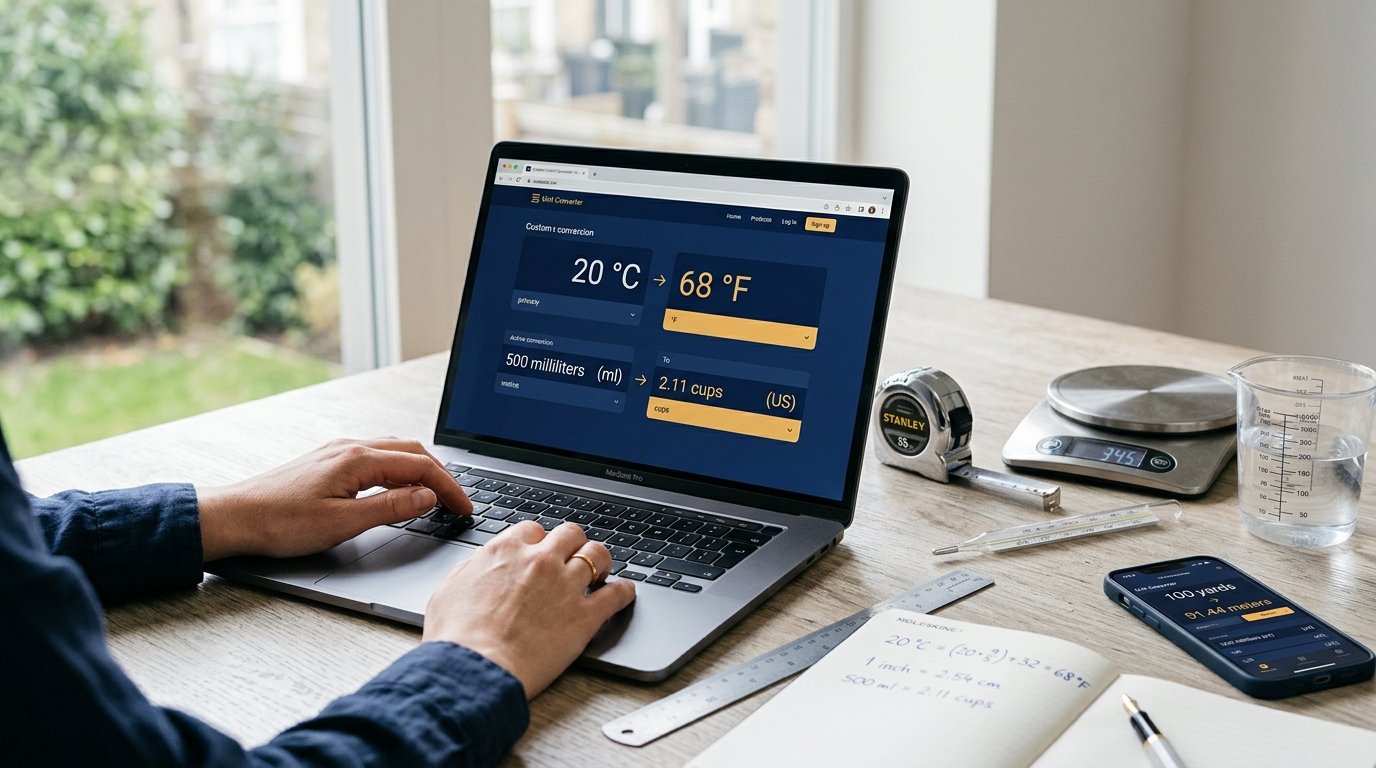
- °F = (°C × 9/5) + 32
- °C = (°F − 32) × 5/9
- K = °C + 273.15
- °C = K − 273.15
Checks: 0 °C = 32 °F = 273.15 K; 100 °C = 212 °F = 373.15 K; −40 °C = −40 °F.
Volume Conversion
Liquid volume is where US and Imperial units diverge most. Always confirm which gallon or pint a source means.
- 1 L = 1,000 ml
- 1 m³ = 1,000 L
- 1 US gal = 3.785411784 L exactly
- 1 Imp gal = 4.54609 L
- 1 US cup = 236.5882365 ml
Example: 2 US gallons → 2 × 3.785411784 ≈ 7.571 L.
Area Conversion
Area factors are length factors squared. Land units add hectares and acres.
- 1 m² = 10,000 cm²
- 1 ha = 10,000 m²
- 1 km² = 1,000,000 m² = 100 ha
- 1 acre = 4,046.8564224 m² ≈ 0.4047 ha
- 1 ft² = 0.09290304 m²
Example: 2 hectares = 20,000 m² ≈ 4.942 acres.
Speed Conversion
Speed is distance over time. Common everyday pairs are km/h and mph; science prefers m/s; aviation and marine use knots.
- 1 m/s = 3.6 km/h exactly
- 1 mph = 1.609344 km/h
- 1 kn = 1.852 km/h exactly (international knot)
Example: 100 km/h → 100 ÷ 3.6 ≈ 27.778 m/s ≈ 62.137 mph.
Time Conversion
Time uses fixed sexagesimal relationships for everyday units (ignoring leap seconds for practical conversion).
- 1 min = 60 s
- 1 h = 60 min = 3,600 s
- 1 d = 24 h = 86,400 s
- 1 wk = 7 d = 604,800 s
For adding clock times or timesheets, also try the Time Calculator.
Pressure Conversion
The SI unit of pressure is the pascal (Pa = N/m²). Engineering and meteorology still use bar, atm, psi, and mmHg.
- 1 kPa = 1,000 Pa
- 1 bar = 100,000 Pa
- 1 atm = 101,325 Pa
- 1 psi ≈ 6,894.76 Pa
- 1 mmHg ≈ 133.322 Pa
Example: 1 atm ≈ 14.696 psi.
Energy Conversion
Energy’s SI unit is the joule. Food labels use kilocalories; electricity bills use kilowatt-hours.
- 1 kJ = 1,000 J
- 1 cal (thermochemical) = 4.184 J
- 1 kcal = 4,184 J
- 1 Wh = 3,600 J
- 1 kWh = 3,600,000 J = 3.6 MJ
Example: 1 kWh = 3.6 × 10⁶ J ≈ 860.4 kcal.
Power Conversion
Power is energy per time. The watt (W = J/s) is SI; engines are often rated in horsepower.
- 1 kW = 1,000 W
- 1 mechanical hp ≈ 745.7 W
Example: 100 hp ≈ 74.57 kW.
How Does a Unit Converter Work?
Under the hood, most converters pick a base unit for each category (metre, gram, litre, second, pascal, joule, watt, …). Every other unit stores how many base units equal one of that unit. Conversion is: value × factor_from ÷ factor_to.
Temperature routes through Celsius (or Kelvin) with the offset formulas above. A polished UI then formats the result, shows the factor, and rebuilds a full table for the same input.
Conversion Factor Method
The factor-label (dimensional analysis) method chains fractions that cancel units:
Example: 60 mph → m/s → 60 mi/h × (1,609.344 m / 1 mi) × (1 h / 3,600 s) ≈ 26.822 m/s.
Writing units in the fractions makes mistakes obvious — if a unit does not cancel, the setup is wrong.
Why Conversion Accuracy Matters
Small factor errors grow with large quantities: fuel loads, land area, medication dosing, and structural dimensions all depend on the correct constant. Prefer exact legal definitions (inch–metre, pound–kilogram, US gallon–litre) over rounded memory aids when precision matters.
Common Unit Conversion Mistakes
- Using a ratio for temperature instead of the offset formula
- Confusing US and Imperial liquid measures
- Squaring or cubing the wrong factor for area and volume
- Treating decimal hours as hours-and-minutes (1.30 h ≠ 1 h 30 min)
- Mixing mass (kg) with force (N) or weight on other planets
- Rounding intermediate steps too early
Unit Converter for Everyday Life
Home cooks convert oven temperatures and recipe volumes. Travellers convert road signs and clothing sizes. Online shoppers compare package weights and screen diagonals. A multi-category converter keeps all of those checks in one place.
Unit Converter for Students
Science homework trains dimensional analysis. Students should still show working, but a converter is ideal for checking answers and exploring “what if” values. Pair it with the Scientific Calculator for powers and scientific notation.
Unit Converter for Professionals
Engineers, clinicians, chefs, pilots, and logistics teams convert under time pressure. Standardised factors and clear unit labels reduce costly misreads — especially when documents mix SI and customary units.
How to Choose a Good Unit Converter
- Covers the categories you actually need
- Uses documented SI / NIST factors
- Handles temperature offsets correctly
- Shows formulas or factors for verification
- Works on mobile without sign-up
- Separates US and Imperial volume where relevant
How to Use the CalcWisee Unit Converter
- 1Open the Unit Converter.
- 2Choose a category (Length, Weight, Temperature, …).
- 3Select From and To units and enter a value (decimals allowed).
- 4Read the instant result, formula, and step breakdown.
- 5Scan the live table for all units in that category.
- 6Use Swap, Copy, Reset, or Share as needed.
Frequently Asked Questions
What is a Unit Converter?
It is a tool that changes a measurement from one unit to another while keeping the same physical quantity, using standard conversion factors or temperature formulas.
How do I convert kilometres to miles?
Divide kilometres by 1.609344 (or multiply by ≈0.621371). Example: 10 km ≈ 6.214 miles.
How do I convert kilograms to pounds?
Multiply kilograms by ≈2.20462. Example: 70 kg ≈ 154.32 lb. Exactly, 1 lb = 0.45359237 kg.
Why is temperature conversion different?
Celsius, Fahrenheit, and Kelvin have different zero points, so conversion needs multiplication and addition/subtraction, not a single factor alone.
What is the difference between US and Imperial gallons?
A US gallon is about 3.785 L; an Imperial gallon is about 4.546 L. Always check which system a fuel or recipe figure uses.
Can I convert negative numbers?
Yes for most categories. Negative kelvin values are invalid because absolute zero is 0 K.
Is the CalcWisee Unit Converter free?
Yes. It is free, requires no registration, and runs in your browser on any device.
Which references define the conversion factors?
International SI definitions maintained by BIPM, with practical factors published by NIST and related standards bodies.
Related CalcWisee Calculators & Converters
Explore more free tools:
- Unit Converter — ten categories in one tool
- Length Converter — metric and imperial length
- Weight Converter — mass units
- Temperature Converter — °C, °F, K
- Time Calculator — add, subtract, and convert time
- Currency Converter — live exchange rates
- Scientific Calculator — trig, logs, powers
- Browse the full All Calculators directory.
Authoritative Measurement References
- NIST — National Institute of Standards and Technology
- BIPM — Bureau International des Poids et Mesures (SI)
- NIST Guide to the SI
Conclusion
Unit conversion is simple once you know whether you need a pure factor or a temperature formula — and which regional definition applies. Our Unit Converter applies exact everyday factors across ten categories, shows the working, and keeps a live table open for double-checks.
Important Disclaimer
This Unit Converter is provided for educational and informational purposes. Results use standard SI and customary conversion factors. For regulated, medical, legal, or safety-critical work, verify values against calibrated instruments and the applicable official standard.
Try it yourself
Put this guide into practice with our free tool.
CalcWisee Editorial Team
Calculator development and formula review
CalcWisee is an independent site founded by Ayman. Every calculator is built from a published formula or official definition, tested against hand-worked examples before it goes live, and corrected promptly when a reader reports an issue to ayman@calcwisee.com.
Expertise: Financial mathematics, Health and fitness formulas, Applied mathematics, Unit conversion standards