Annealing Temperature Calculator
Estimate PCR primer melting temperature (Tm) and recommended annealing temperature from a DNA sequence.
Reviewed October 7, 2026 Runs in your browser — inputs are never stored
This calculator provides educational estimates of PCR primer melting temperature (Tm) and annealing temperature. Actual PCR conditions depend on primer sequence, buffer composition, salt concentration, polymerase, and reaction conditions. Use the calculated temperature as a starting point and optimize it experimentally according to your laboratory protocol.
About the Annealing Temperature Calculator
Estimate PCR primer melting temperature (Tm) and recommended annealing temperature from a DNA sequence. This biology calculator on CalcWisee is built for students, lab learners, educators, and curious readers who need a transparent, formula-based estimate without installing software. Enter the values described in each field, keep units consistent, and review the worked example so you understand how the result was produced. The tool is ideal for homework checks, lab prep, teaching demos, and quick scenario comparisons when you change one variable at a time. Results update instantly in your browser and are never uploaded to a CalcWisee server, which keeps classroom and personal figures private. Use the tips and common-mistakes guidance on the page to avoid unit mix-ups, dilution errors, and over-interpretation of screening numbers. When a result could affect animal care, clinical decisions, or graded research, confirm the method and inputs with an instructor, veterinarian, or laboratory protocol — online estimates support learning but do not replace professional or institutional guidance.
How to use it
- 1Read the field labels and units before typing any numbers.
- 2Enter each required input using the same unit system throughout.
- 3Press Calculate and review every row in the result panel.
- 4Compare the output with the formula and example on this page.
- 5Reset and change one variable at a time to explore sensitivity.
Worked example
For a 10-nt primer with 4 G/C and 6 A/T: Tm = 2×6 + 4×4 = 28 °C (Wallace). Anneal at ~23 °C.
How it works
Formula
Tm = 2×(A+T) + 4×(G+C) (Wallace rule); Tm = 64.9 + 41×(G+C − 16.4)/length (GC-based)
Worked numbers
For a 10-nt primer with 4 G/C and 6 A/T: Tm = 2×6 + 4×4 = 28 °C (Wallace). Anneal at ~23 °C.
Tips for better results
- Match organism, life stage, and unit assumptions to your real scenario.
- Write dilution factors and blanks next to spectrophotometer-style inputs.
- Prefer primary measurements over rough guesses when precision matters.
- Log the formula version or page date when you paste results into a report.
Common mistakes to avoid
- Forgetting dilution factors or blank corrections in concentration work.
- Applying human reference ranges to other species without adjustment.
- Mixing µL with mL (or g with mg) on volume and mass fields.
- Treating an educational estimate as veterinary or clinical advice.
Frequently asked questions
A:It is typically 3–5 °C below the primer melting temperature (Tm). Use our recommended value as a starting point and optimise empirically.
A:The Wallace rule (2×AT + 4×GC) works for short primers (<14 nt); the GC-based formula is better for longer primers and standard salt conditions.
A:Low GC content lowers Tm. Aim for 40–60% GC and a primer length of 18–25 bases for robust PCR.
Reviewed for accuracy · Last updated October 7, 2026
Formulas follow published molecular biology, genetics, veterinary, agronomy, and forestry references — including Beer–Lambert DNA/protein quantification, Mendelian inheritance, AAHA/AAFCO nutrition guidelines, USDA grazing and crop standards, and forestry measurement conventions.
CalcWisee Editorial Team
Calculator development and formula review
CalcWisee is an independent site founded by Ayman. Every calculator is built from a published formula or official definition, tested against hand-worked examples before it goes live, and corrected promptly when a reader reports an issue to ayman@calcwisee.com.
Expertise: Financial mathematics, Health and fitness formulas, Applied mathematics, Unit conversion standards
References & sources
Related guides

How Does a Punnett Square Work? A Complete Guide to Genetic Crosses
Understand how Punnett squares predict offspring genotypes and phenotype ratios for monohybrid, dihybrid, and trihybrid crosses — with clear examples, formulas, and a free calculator.

What Is Hardy–Weinberg Equilibrium? Population Genetics Explained
Learn what Hardy–Weinberg equilibrium is, the p² + 2pq + q² = 1 equation, its five assumptions, and how to calculate expected genotype frequencies — with a free calculator.
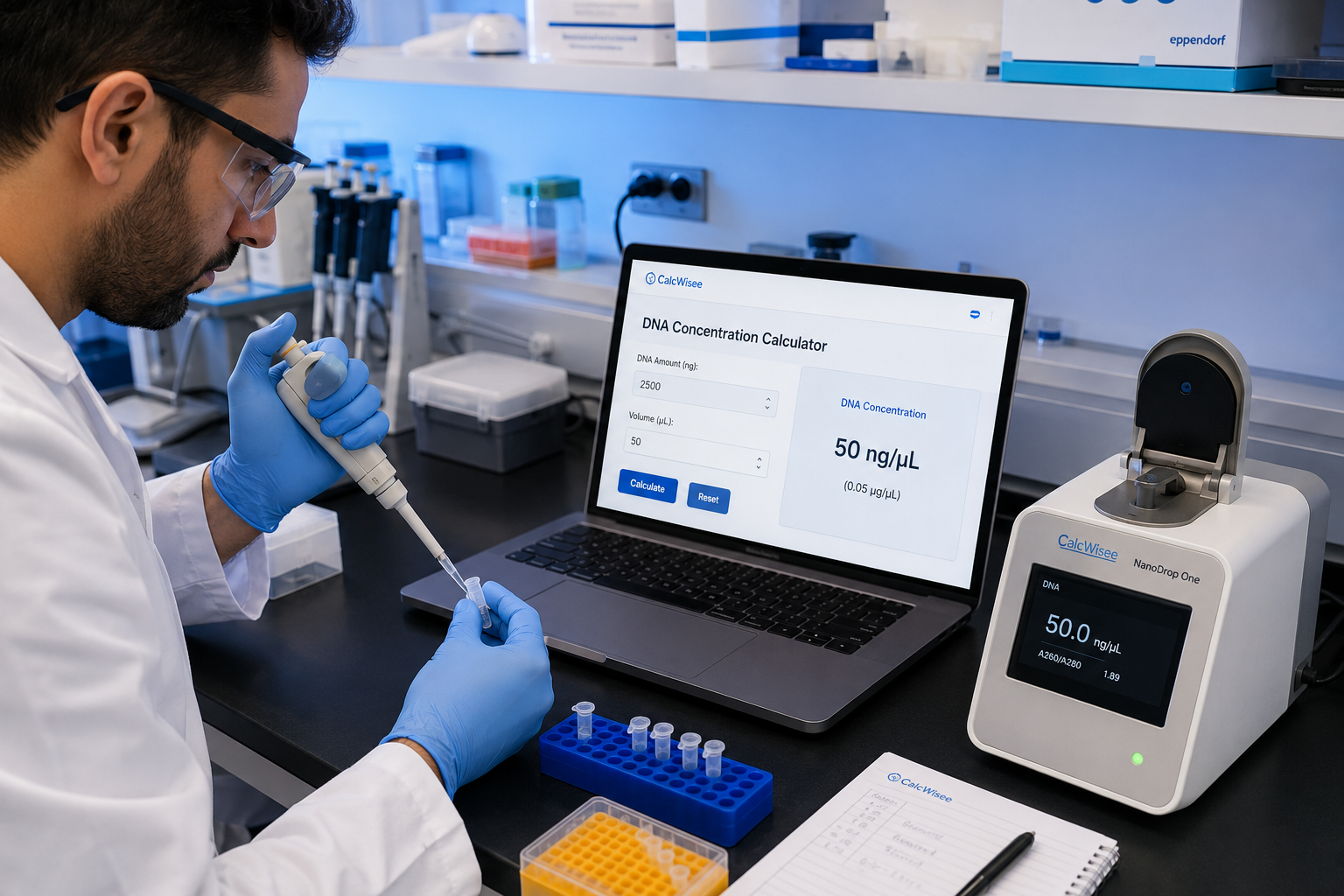
DNA Concentration Calculator: How to Calculate DNA Concentration
Calculate DNA concentration from amount and volume or A260, prepare dilutions, find total DNA, and avoid common lab unit mistakes — with a free multi-mode calculator.