Percentage Calculator: Solve Percentage Problems Easily
Master everyday percentage math — find a percent of a number, reverse percentages, percentage increase and decrease, discounts, tax, and tips — with clear formulas and a free calculator.
Percentages appear everywhere — sale prices, exam scores, investment returns, tips, taxes, and sports stats. A clear Percentage Calculator turns those everyday questions into instant, accurate answers.
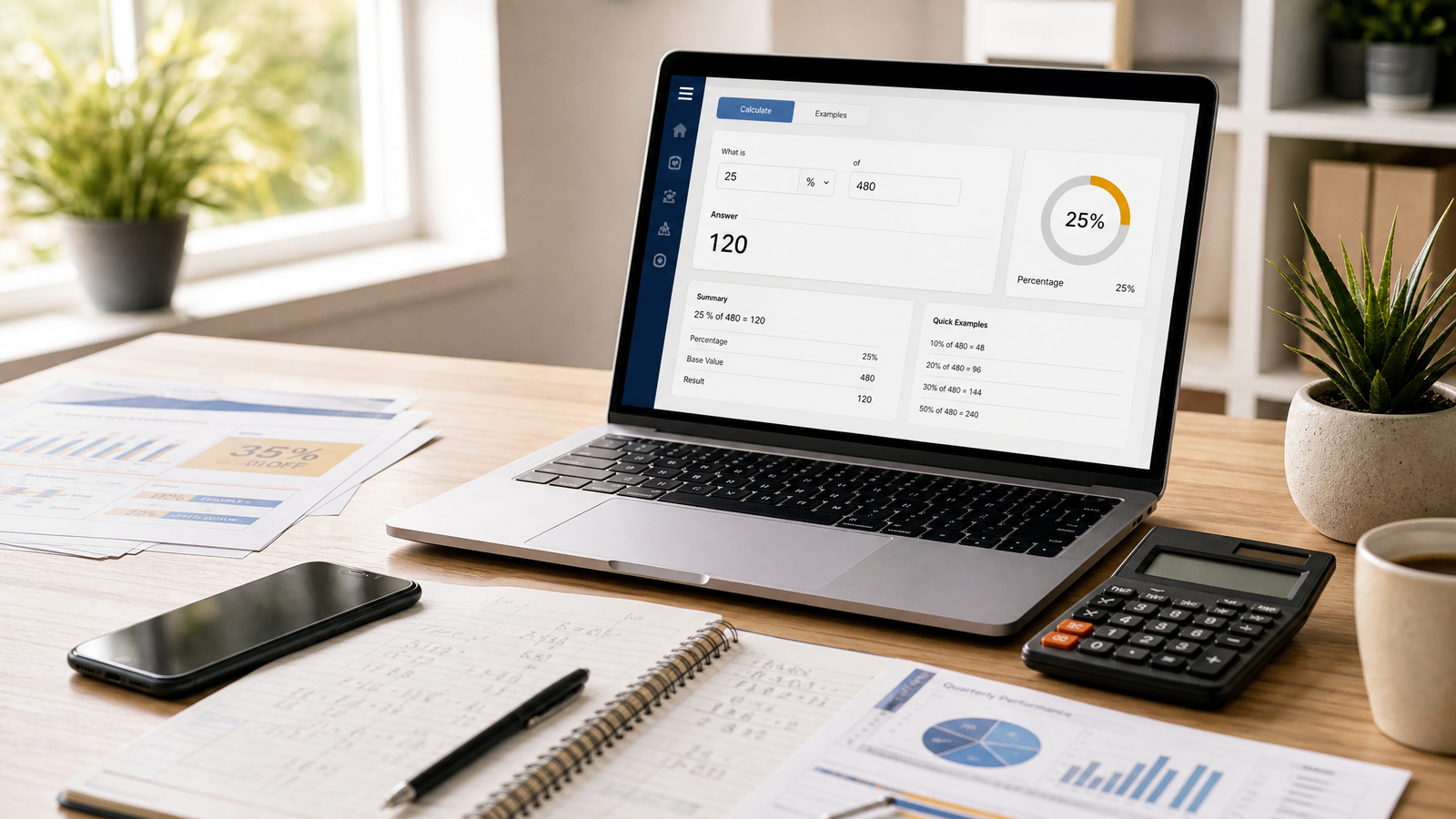
Our free Percentage Calculator supports five core modes: what is X% of Y, X is what % of Y, percentage increase, percentage decrease, and percentage difference — each with the formula and step-by-step breakdown shown on screen.
Try it right here — results update instantly.
What is X% of Y?
Answer
120
25% of 480 = 120
Formula: Result = Y × (X ÷ 100)
Multiply the base value by the percent divided by 100
- Convert percent to decimal: 25 ÷ 100 = 0.25
- Multiply by the base: 480 × 0.25 = 120
- Mode
- X% of Y
- Percentage (X)
- 25%
- Of number (Y)
- 480
- Result
- 120
Quick examples — What is X% of Y?
Learn more about percentage calculations — read our Percentage Calculator guide with formulas, discounts, tips, tax examples, and FAQs.
What Is a Percentage?
A percentage is a way of expressing a number as a fraction of 100. The word comes from the Latin per centum — “by the hundred.” So 25% means 25 per 100, or 25/100 = 0.25.
Percentages make comparisons easy because every value is scaled to the same base of 100. Saying “sales grew 12%” is clearer than saying “sales grew by 0.12 times the previous amount.”
Basic Percentage Formula
The fundamental relationship is:
Part = Whole × (Percentage ÷ 100)
Equivalently, Percentage = (Part ÷ Whole) × 100. Every percentage problem is a rearrangement of this relationship.
How to Calculate a Percentage of a Number
To find X% of Y, multiply Y by X ÷ 100.
Example: What is 20% of 150? 150 × (20 ÷ 100) = 150 × 0.20 = 30.
Example: What is 25% of 480? 480 × 0.25 = 120.
How to Find What Percentage One Number Is of Another
To find what percent X is of Y: (X ÷ Y) × 100.
Example: 30 is what percent of 120? (30 ÷ 120) × 100 = 25%.
Example: 45 is what percent of 60? (45 ÷ 60) × 100 = 75%.
If Y is zero, the percentage is undefined — you cannot divide by zero.
How to Calculate Percentage Increase
Percentage increase measures growth relative to the original value:
[(New − Original) ÷ Original] × 100
Example: From 80 to 100 → [(100 − 80) ÷ 80] × 100 = 25% increase.
Example: From 100 to 150 → [(150 − 100) ÷ 100] × 100 = 50% increase.
How to Calculate Percentage Decrease
Percentage decrease measures a drop relative to the original:
[(Original − New) ÷ Original] × 100
Example: From 200 to 150 → [(200 − 150) ÷ 200] × 100 = 25% decrease.
Example: From 100 to 80 → [(100 − 80) ÷ 100] × 100 = 20% decrease.
Percentage Change
Percentage change is the signed version of increase/decrease: positive when the new value is higher, negative when it is lower. The formula is the same as percentage increase; a negative result means a decrease.
Always divide by the original (starting) value — not the new value — or the result will be wrong.
Percentage Difference
Percentage difference compares two values without treating one as the “original.” It uses the average as the baseline:
|A − B| ÷ [(A + B) ÷ 2] × 100
Example: Difference between 80 and 100 → |80 − 100| ÷ 90 × 100 ≈ 22.22%.
Use percentage difference when neither value is a natural baseline (for example, comparing two lab measurements). Use percentage change when there is a clear before/after.
Percentage Points vs. Percentage Change
If an interest rate moves from 4% to 6%, that is a rise of 2 percentage points, but a 50% relative increase ((6 − 4) ÷ 4 × 100). Confusing points with percent change is a common source of misleading headlines.
- Percentage points — absolute difference between two percentage figures.
- Percentage change — relative difference compared with the starting value.
Calculating Discounts
A 30% off sale means you pay 70% of the original price. Discount amount = Original × (Discount% ÷ 100). Sale price = Original − Discount amount, or Original × (1 − Discount% ÷ 100).
Example: $80 item at 25% off → discount = 20; sale price = $60. You can compute the discount amount with “X% of Y” mode, then subtract from the original price.
Calculating Sales Tax
Sales tax is usually a percentage added to the pre-tax price. Tax = Price × (Rate ÷ 100). Total = Price + Tax = Price × (1 + Rate ÷ 100).
Example: $50 with 8% tax → tax = $4; total = $54.
Calculating Tips
A tip is a percentage of the bill. Tip = Bill × (Tip% ÷ 100). Total = Bill + Tip.
Example: $64 bill with 18% tip → tip = $11.52; total ≈ $75.52. Common tip rates are 15%, 18%, and 20%.
Why Percentage Calculations Can Be Confusing
- Choosing the wrong base (dividing by the new value instead of the original).
- Mixing percentage points with percentage change.
- Stacking percentages incorrectly (a 10% rise then a 10% fall does not return to the start).
- Forgetting that percent of a percent needs two conversions to decimal form.
- Division by zero when the original or whole is 0.
Common Percentage Examples
| Question | Calculation | Result |
|---|---|---|
| 20% of 150 | 150 × 0.20 | 30 |
| 25% of 480 | 480 × 0.25 | 120 |
| 15% of 200 | 200 × 0.15 | 30 |
| 30 is what % of 120 | (30 ÷ 120) × 100 | 25% |
| 45 is what % of 60 | (45 ÷ 60) × 100 | 75% |
| Increase 80 → 100 | (20 ÷ 80) × 100 | 25% |
| Increase 100 → 150 | (50 ÷ 100) × 100 | 50% |
| Decrease 200 → 150 | (50 ÷ 200) × 100 | 25% |
| Decrease 100 → 80 | (20 ÷ 100) × 100 | 20% |
| Difference 80 vs 100 | 20 ÷ 90 × 100 | ≈ 22.22% |
Where Are Percentages Used?
- Retail — discounts, markups, and sale pricing
- Finance — interest rates, returns, fees, and taxes
- Education — exam scores and grade weights
- Health and fitness — body fat, progress toward goals
- Business — margins, growth rates, and market share
- Sports — shooting percentages, win rates, and completion rates
- Science and statistics — relative error and composition
Percentage Calculator vs. Manual Calculation
Manual calculation builds intuition and is fine for simple mental math (10%, 25%, 50%). A calculator shines when you need decimals, reverse percentages, increase/decrease, or percentage difference without arithmetic mistakes — and when you want the formula and steps visible for learning or checking homework.
How to Use the CalcWisee Percentage Calculator
- 1Choose a mode: X% of Y, X is what % of Y, % Increase, % Decrease, or % Difference.
- 2Enter the two values in the labeled fields.
- 3Read the answer, formula, and step-by-step breakdown instantly.
- 4Tap a quick example to load common scenarios.
- 5Copy or share the result, or reset to start over.
Frequently Asked Questions
What is a Percentage Calculator?
It is a tool that solves common percentage problems — finding a percent of a number, reverse percentages, increase, decrease, and difference — using standard formulas.
How do I calculate a percentage of a number?
Multiply the number by the percent divided by 100. Example: 15% of 200 = 200 × 0.15 = 30.
How do I calculate percentage increase?
Subtract the original from the new value, divide by the original, and multiply by 100.
How do I calculate percentage decrease?
Subtract the new value from the original, divide by the original, and multiply by 100.
What is the difference between percentage change and percentage difference?
Percentage change uses one value as the baseline (before/after). Percentage difference uses the average of both values and is symmetric.
How do I calculate a discount?
Discount amount = price × (discount% ÷ 100). Sale price = price − discount, or price × (1 − discount% ÷ 100).
Can percentages be greater than 100%?
Yes. Values above 100% mean the part is larger than the whole, or growth more than doubled the original.
Is the CalcWisee Percentage Calculator free?
Yes. It is free, requires no sign-up, and runs in your browser on any device.
Related CalcWisee Calculators
Explore more free tools:
- Percentage Calculator — five percentage modes with formulas
- Fraction Calculator — add, subtract, multiply, divide fractions
- Ratio Calculator — simplify ratios and proportions
- Currency Converter — live exchange rates
- Length Converter — metric and imperial length
- Temperature Converter — °C, °F, K
- Volume Converter — litres, gallons, and more
- Area Converter — m², ft², acres, hectares
- Browse the full All Calculators directory.
Conclusion
Once you know which percentage problem you face — a part of a whole, a reverse percent, growth, decline, or a symmetric difference — the math is straightforward. Our Percentage Calculator applies the correct formula, shows the steps, and handles decimals and edge cases for you.
Important Disclaimer
This Percentage Calculator is provided for educational and informational purposes. Results use standard arithmetic formulas. For financial, tax, legal, or other high-stakes decisions, verify figures with a qualified professional and official sources.
Reliable References
Try it yourself
Put this guide into practice with our free tool.
CalcWisee Editorial Team
Calculator development and formula review
CalcWisee is an independent site founded by Ayman. Every calculator is built from a published formula or official definition, tested against hand-worked examples before it goes live, and corrected promptly when a reader reports an issue to ayman@calcwisee.com.
Expertise: Financial mathematics, Health and fitness formulas, Applied mathematics, Unit conversion standards
References & sources