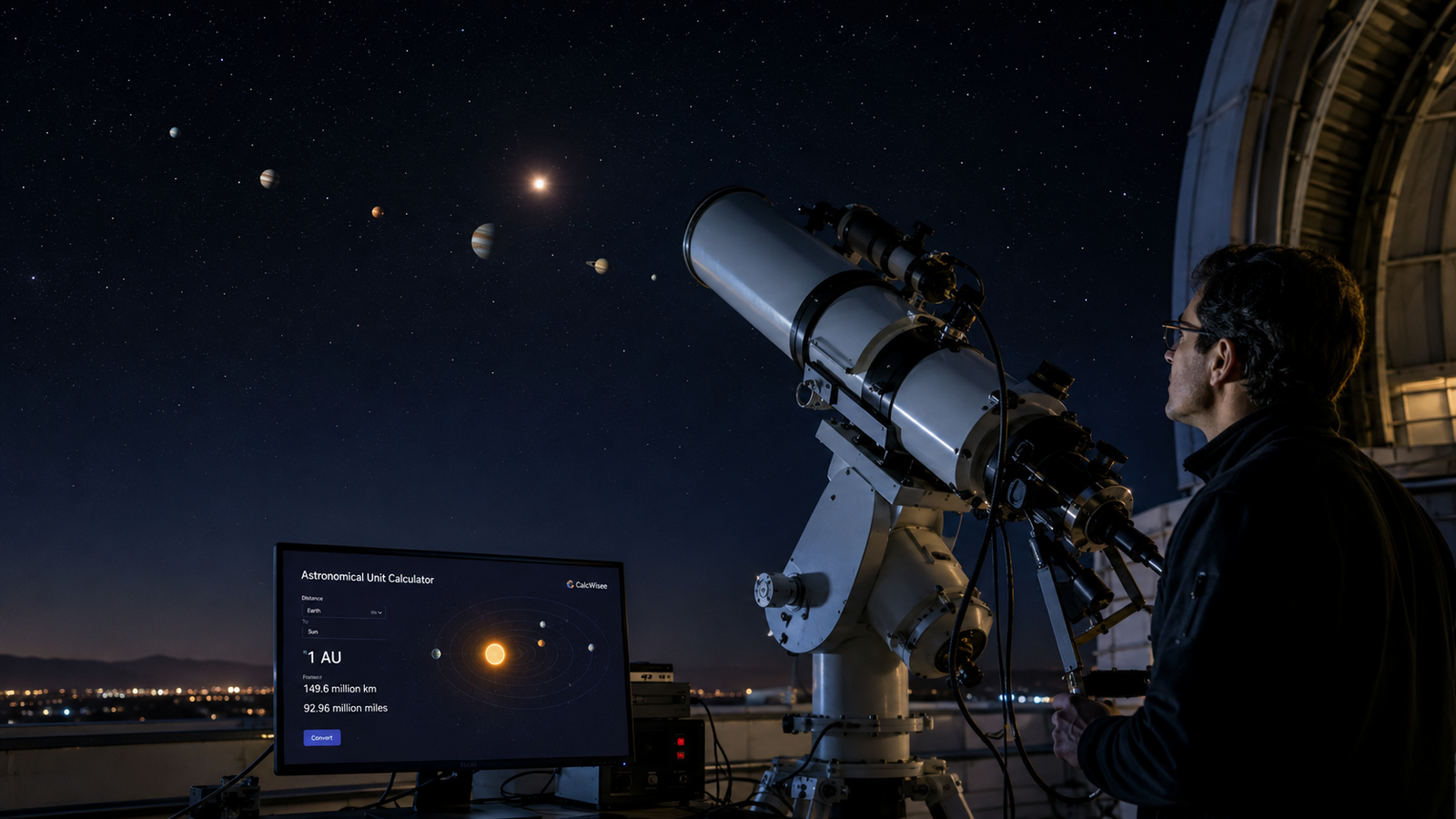
Orbital Velocity Calculator
Calculate the circular orbital velocity at any radius using v = √(GM/r), with presets for the ISS, geostationary orbit, and Earth's path around the Sun.
Reviewed October 7, 2026 Runs in your browser — inputs are never stored
Distance from the body's centre, not altitude.
Presets
Formula
v = √(GM ÷ r) · circular orbit · escape velocity = √2 × v
This tool provides educational conversions of astronomical distances only. It is not a navigation, mission-planning, or ephemeris service. For professional or spacecraft work, use official IAU, NASA, or observatory data products.
About the Orbital Velocity Calculator
The orbital velocity calculator finds the speed needed to stay in a circular orbit at a given distance from a body’s centre, using v = √(GM / r). Lower orbits require higher speeds: the International Space Station travels at about 7.7 km/s, while the Moon moves at about 1 km/s around Earth. Circular orbital velocity is always √2 times smaller than the escape velocity at the same distance.
How to use it
- 1Choose the central body.
- 2Enter the orbital radius (distance from the body's centre, not altitude).
- 3Press Calculate to get the circular orbital velocity.
Worked example
the ISS at about 6,778 km from Earth's centre orbits at roughly 7,669 m/s (7.67 km/s). Earth around the Sun at 1 AU moves at about 29.78 km/s.
How it works
The orbital velocity formula
For a circular orbit, gravity provides the centripetal force: GMm/r² = mv²/r, giving v = √(GM/r). The closer the orbit, the faster the body moves.
Reference velocities
- ISS (~400 km altitude): ≈ 7.67 km/s
- Geostationary orbit: ≈ 3.07 km/s
- Earth around the Sun (1 AU): ≈ 29.78 km/s
Who it is for
Satellite engineers, astronomy students, and anyone studying orbital mechanics.
Why it helps
Orbital velocity is the speed needed to maintain a circular orbit — critical for satellite deployment, station-keeping, and understanding planetary motion.
Common use cases
- Finding the speed of a satellite at a given altitude
- Comparing low-Earth orbit vs geostationary velocities
- Teaching circular orbit dynamics
- Sanity-checking spacecraft speed requirements
Tips for better results
- Use distance from the body's centre, not altitude above the surface.
- Escape velocity is √2 × circular orbital velocity at the same radius.
- Lower orbits are faster — the ISS outpaces geostationary satellites.
- For elliptical orbits, velocity varies; this gives the circular value.
Common mistakes to avoid
- Entering altitude instead of radius from the body's centre.
- Confusing orbital velocity with escape velocity.
- Using the wrong central mass for the orbit in question.
Frequently asked questions
A:Orbital velocity is the speed needed to maintain a stable circular orbit at a given radius around a massive body: v = √(GM/r).
A:Escape velocity is √2 times the circular orbital velocity at the same radius. Orbital velocity keeps you in orbit; escape velocity breaks free entirely.
A:Lower orbits have a smaller radius r, so v = √(GM/r) is larger. The ISS orbits at ~7.67 km/s while geostationary satellites move at ~3.07 km/s.
A:Yes. It runs in your browser on CalcWisee with no sign-up required.
Reviewed for accuracy · Last updated October 7, 2026
The astronomical unit is taken as exactly 149,597,870,700 metres per the IAU 2012 definition. Related light-time and light-year factors use the defined speed of light and the IAU Julian year where applicable.
CalcWisee Editorial Team
Calculator development and formula review
CalcWisee is an independent site founded by Ayman. Every calculator is built from a published formula or official definition, tested against hand-worked examples before it goes live, and corrected promptly when a reader reports an issue to ayman@calcwisee.com.
Expertise: Financial mathematics, Health and fitness formulas, Applied mathematics, Unit conversion standards
References & sources