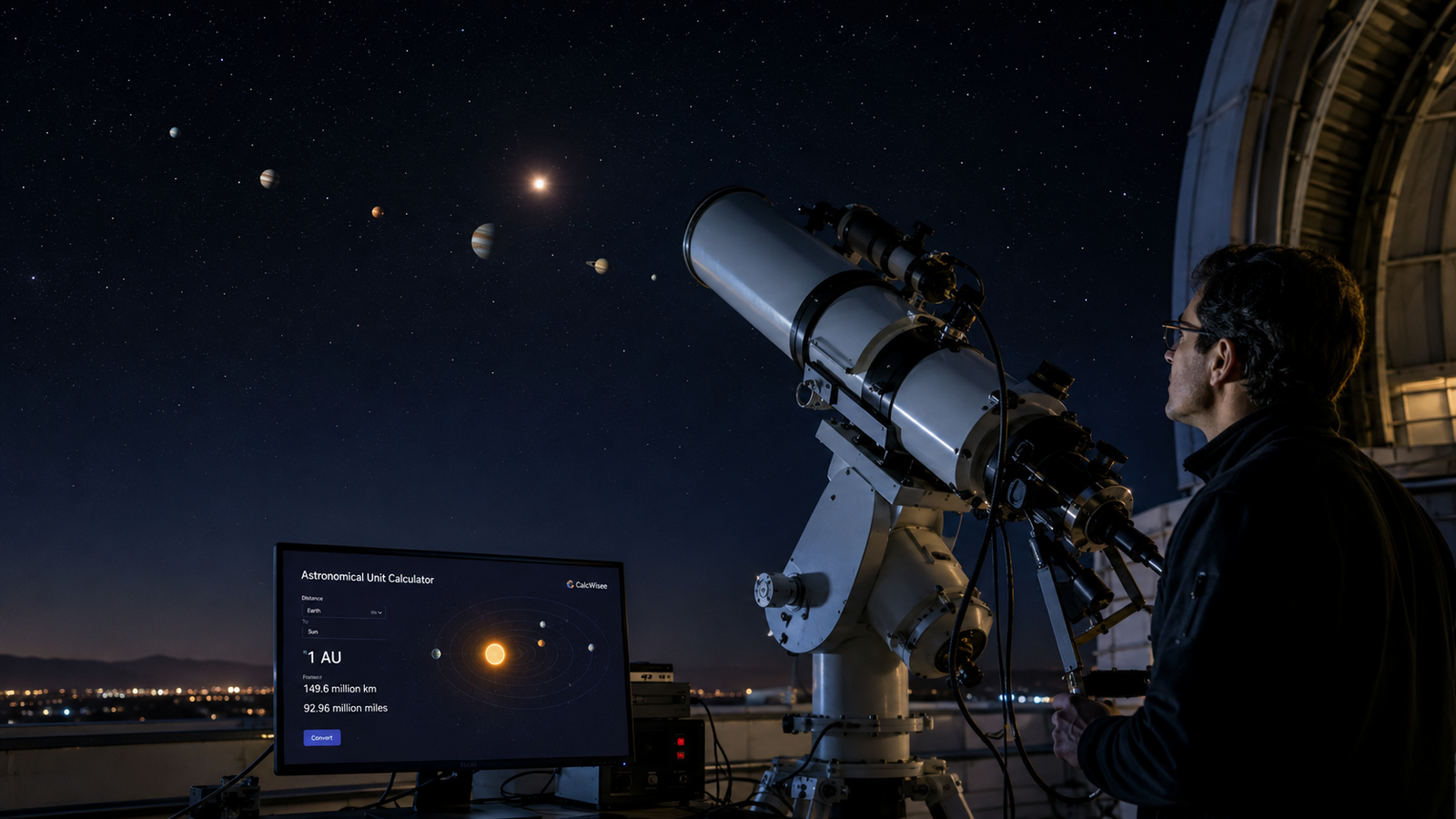
Stellar Magnitude Calculator
Calculate stellar distances from the distance modulus m − M = 5 log10(d/10 pc), or find absolute magnitude from apparent magnitude and distance.
Reviewed October 7, 2026 Runs in your browser — inputs are never stored
Formula
m − M = 5 × log10(d ÷ 10 pc) · d(pc) = 10 × 10^((m−M)/5)
This tool provides educational conversions of astronomical distances only. It is not a navigation, mission-planning, or ephemeris service. For professional or spacecraft work, use official IAU, NASA, or observatory data products.
About the Stellar Magnitude Calculator
The stellar magnitude calculator works with the logarithmic scale astronomers use for brightness. On this scale a difference of 5 magnitudes equals a brightness ratio of exactly 100, so each single magnitude step is a factor of about 2.512, and smaller numbers mean brighter objects. The tool converts magnitude differences into brightness ratios and links apparent magnitude, absolute magnitude and distance through the distance modulus.
How to use it
- 1Choose whether to solve for distance (from m and M) or absolute magnitude (from m and distance).
- 2Enter the apparent magnitude and the other known value.
- 3Press Calculate to get the result with the distance modulus breakdown.
Worked example
a star with apparent magnitude m = 4 and absolute magnitude M = 1 has a distance modulus of 3, giving d = 10 × 10^(3/5) = 39.8 pc (about 130 ly).
How it works
The distance modulus
The difference between apparent magnitude m and absolute magnitude M relates to distance by m − M = 5 × log10(d ÷ 10 pc). Solving for distance: d = 10 × 10^((m−M)/5) parsecs.
The magnitude scale
Astronomical magnitudes are logarithmic and inverted: brighter stars have smaller numbers. A difference of 5 magnitudes equals a brightness ratio of exactly 100.
Who it is for
Astronomy students, amateur observers, and researchers working with stellar brightness and distance.
Why it helps
The distance modulus is one of the most important tools in astronomy for measuring distances to stars and galaxies from their observed brightness.
Common use cases
- Finding a star's distance from its apparent and absolute magnitude
- Determining absolute magnitude from observed brightness and parallax distance
- Teaching the magnitude scale and distance modulus
- Cross-checking stellar distance estimates
Tips for better results
- The distance modulus (m − M) is 0 at 10 pc by definition.
- Lower (more negative) magnitudes mean brighter objects.
- Use this with the Parallax Distance Calculator for cross-checks.
- Extinction by dust increases m, so distances can be overestimated without correction.
Common mistakes to avoid
- Confusing apparent (m) and absolute (M) magnitude inputs.
- Forgetting that the formula uses parsecs, not light-years.
- Ignoring interstellar extinction, which makes stars look dimmer (larger m).
Frequently asked questions
A:The distance modulus is m − M, the difference between apparent and absolute magnitude. It equals 5 log10(d/10 pc), so it directly yields a star's distance in parsecs.
A:Absolute magnitude (M) is the apparent magnitude a star would have at a standard distance of 10 parsecs. It measures intrinsic luminosity.
A:The scale originated with the ancient Greeks, who called the brightest stars "first magnitude." Modern logarithmic magnitudes preserve that convention: smaller numbers mean brighter objects.
A:Yes. It runs in your browser on CalcWisee with no sign-up required.
Reviewed for accuracy · Last updated October 7, 2026
The astronomical unit is taken as exactly 149,597,870,700 metres per the IAU 2012 definition. Related light-time and light-year factors use the defined speed of light and the IAU Julian year where applicable.
CalcWisee Editorial Team
Calculator development and formula review
CalcWisee is an independent site founded by Ayman. Every calculator is built from a published formula or official definition, tested against hand-worked examples before it goes live, and corrected promptly when a reader reports an issue to ayman@calcwisee.com.
Expertise: Financial mathematics, Health and fitness formulas, Applied mathematics, Unit conversion standards
References & sources