DNA Concentration Calculator: How to Calculate DNA Concentration
Calculate DNA concentration from amount and volume or A260, prepare dilutions, find total DNA, and avoid common lab unit mistakes — with a free multi-mode calculator.
Measuring DNA concentration is an essential part of many molecular biology workflows. Whether you are preparing samples for PCR, qPCR, sequencing, cloning, or other laboratory applications, knowing how much DNA is present in a sample helps you work with the appropriate amount of material.
The DNA Concentration Calculator simplifies common DNA concentration calculations and helps researchers, students, and laboratory professionals understand the relationship between DNA amount, sample volume, absorbance, and dilution.
In this guide, you will learn how DNA concentration is calculated, how A260 measurements can be used, how dilution affects concentration, how to calculate total DNA amount, and how to avoid common laboratory calculation mistakes.
Try it right here — results update instantly.
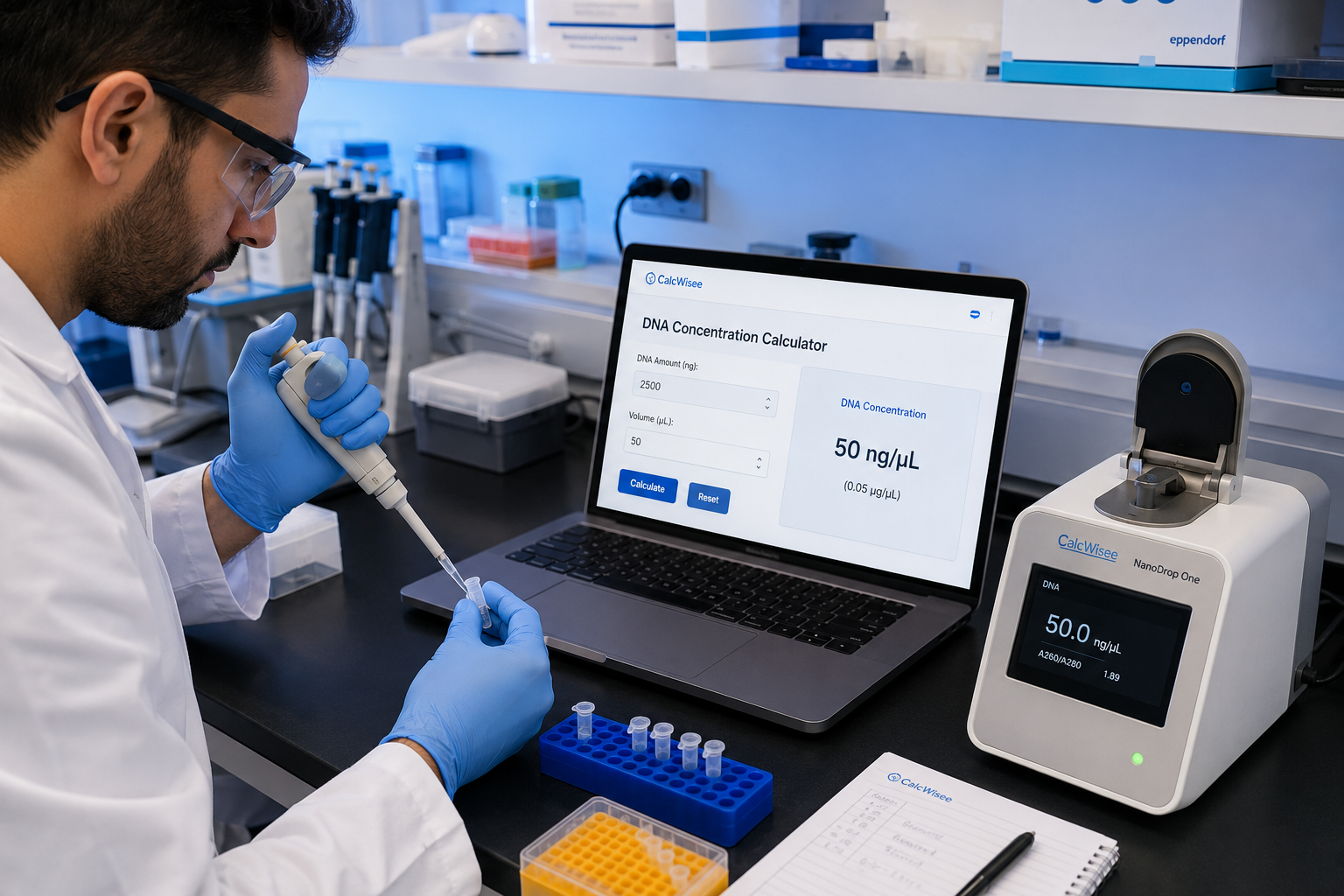
DNA Concentration Calculator
Amount/volume · A260 · dilution · total DNA · pipette volume
Result
50 ng/µL
(50 µg/mL)
Concentration = DNA amount ÷ volume. 1 ng/µL = 1 µg/mL.
Read the DNA Concentration Calculator guide
Educational laboratory calculation aid only. A260 factors are reference approximations. Follow validated protocols and manufacturer instructions for research or regulated work. Not a substitute for instrument calibration or clinical advice.
What Is DNA Concentration?
DNA concentration represents the amount of DNA contained in a specific volume of solution. It is commonly expressed using units such as ng/µL (nanograms per microliter), µg/mL (micrograms per milliliter), and mg/mL (milligrams per milliliter).
One of the most commonly used laboratory units is ng/µL. For example, a concentration of 50 ng/µL means that approximately 50 nanograms of DNA are present in every microliter of the sample.
Why Is DNA Concentration Important?
Accurate DNA quantification is important because many molecular biology protocols require a specific amount of DNA. DNA concentration can be relevant when preparing PCR reactions, qPCR experiments, sequencing libraries, cloning reactions, restriction digests, DNA normalization, molecular biology standards, and research samples.
Using an inappropriate amount of DNA can affect the consistency and performance of downstream experiments.
How to Calculate DNA Concentration
The simplest concentration equation is: DNA Concentration = DNA Amount ÷ Volume.
For example, if a sample contains 500 ng of DNA in a volume of 10 µL: 500 ng ÷ 10 µL = 50 ng/µL. Therefore, the DNA concentration is 50 ng/µL. This basic relationship is useful when the DNA amount and sample volume are already known. In the calculator, choose Amount ÷ Volume and enter matching mass and volume units.
DNA Concentration From A260 Absorbance
DNA can also be estimated using UV absorbance around 260 nm. A commonly used reference factor for double-stranded DNA is A260 of 1.0 ≈ 50 µg/mL dsDNA. Treat this as a reference rather than a universal constant.
| Sample Type | Approximate concentration at A260 = 1.0 |
|---|---|
| Double-stranded DNA | 50 µg/mL |
| Single-stranded DNA | 33 µg/mL |
| RNA | 40 µg/mL |
A practical estimate is: concentration (µg/mL) ≈ (A260 ÷ path length in cm) × factor × dilution factor. Standard cuvettes often use a 1 cm path length; micro-volume instruments may report path-length-corrected absorbance — follow the instrument documentation.
Example: Calculate dsDNA Concentration From A260
Suppose A260 = 0.4. Using the dsDNA reference factor at 1 cm path length and no dilution: 0.4 × 50 µg/mL = 20 µg/mL = 20 ng/µL. Therefore, DNA concentration is approximately 20 ng/µL. If the sample was diluted 10× before reading, multiply by the dilution factor as well.
DNA Concentration and Dilution
Use the standard dilution equation C1V1 = C2V2, where C1 is the initial concentration, V1 is stock volume, C2 is the desired final concentration, and V2 is the final volume.
For a 100 ng/µL stock, preparing 20 µL at 25 ng/µL requires: V1 = (25 × 20) ÷ 100 = 5 µL. Use 5 µL DNA stock + 15 µL diluent, assuming ideal mixing and accurate pipetting. The calculator Dilution mode solves this with unit selectors for ng/µL, µg/mL, and related units.
How to Calculate Total DNA Amount
DNA Amount = DNA Concentration × Volume. For example, 40 ng/µL × 25 µL = 1,000 ng = 1 µg.
The reverse is also common in the lab: volume to pipette = target amount ÷ concentration. If a sample is 80 ng/µL and you need 400 ng, volume = 400 ÷ 80 = 5 µL.
DNA Concentration vs. DNA Purity
Concentration and purity are different measurements. A260/A280 and A260/A230 can provide quality indicators, but they do not replace appropriate sample-quality assessment. A ratio around 1.8 is often used as a dsDNA reference under suitable conditions.
- A260/A280 near ~1.8 is often cited for relatively pure dsDNA under suitable conditions.
- A260/A230 is sometimes used as an additional quality indicator for salts and organics.
- Neither ratio replaces gel electrophoresis, fluorometric assays, or protocol-specific QC when those are required.
Common DNA Concentration Calculation Mistakes
Mixing Up Concentration and Total Amount
50 ng/µL is a concentration; 50 ng is an amount. Confusing them leads to large pipetting errors.
Forgetting the Dilution Factor
If a sample was diluted before measurement, account for the dilution when estimating the original stock concentration.
Using the Wrong A260 Conversion Factor
The reference factor for dsDNA differs from ssDNA and RNA. Using 50 for RNA or ssDNA systematically biases the estimate.
Confusing ng/µL With ng/mL
1 ng/µL = 1 µg/mL, while ng/mL differs by a factor of 1,000.
Quick DNA Concentration Conversion Table
| DNA Concentration | Equivalent |
|---|---|
| 1 ng/µL | 1 µg/mL |
| 10 ng/µL | 10 µg/mL |
| 25 ng/µL | 25 µg/mL |
| 50 ng/µL | 50 µg/mL |
| 100 ng/µL | 100 µg/mL |
| 500 ng/µL | 500 µg/mL |
| 1,000 ng/µL | 1 mg/mL |
How to Use the DNA Concentration Calculator
- 1Open the DNA Concentration Calculator.
- 2Select the mode that matches your data: amount ÷ volume, A260, dilution, total DNA, or volume for a target amount.
- 3Enter available DNA amount, sample volume, absorbance, or dilution values with compatible units.
- 4Review the primary result and unit equivalents (ng/µL and µg/mL where applicable).
- 5Compare outputs with the requirements of your validated laboratory protocol — not as a substitute for it.
Practical Laboratory Example
If a DNA sample is 80 ng/µL and a researcher needs 400 ng: Volume = Amount ÷ Concentration = 400 ÷ 80 = 5 µL. Therefore, approximately 5 µL contains 400 ng DNA. Use the calculator Volume for amount mode to check decimals and large values quickly.
DNA Concentration for PCR and Other Applications
There is no single concentration suitable for every experiment. Requirements depend on the protocol, reaction volume, DNA quality, enzyme system, instrument, sample type, and experimental design. Use this calculator as a calculation aid, not as a substitute for a validated protocol.
Frequently Asked Questions
What is DNA concentration?
DNA concentration is the amount of DNA per unit volume, commonly expressed in ng/µL (which equals µg/mL numerically).
How do you calculate DNA concentration?
For a simple sample: DNA Concentration = DNA Amount ÷ Volume. Absorbance estimates use A260 and an appropriate reference factor, scaled by path length and dilution when needed.
What is the A260 conversion factor for dsDNA?
Approximately 50 µg/mL at A260 = 1.0 under standard 1 cm path-length reference conditions. Treat this as a reference approximation, not a universal constant.
Is ng/µL equal to µg/mL?
Yes. 1 ng/µL = 1 µg/mL. Do not confuse ng/µL with ng/mL, which differs by a factor of 1,000.
What is the difference between DNA concentration and DNA amount?
Concentration is quantity per volume (for example 50 ng/µL). Amount is the total quantity (for example 50 ng or 1 µg).
Does DNA concentration indicate DNA purity?
No. Concentration and purity are different characteristics. Ratios such as A260/A280 can support quality checks but do not replace full sample assessment when required.
Why is accurate DNA quantification important?
It helps researchers use appropriate DNA quantities and maintain consistency between samples in PCR, sequencing, cloning, and related workflows.
Related CalcWisee Tools
- DNA Concentration Calculator — multi-mode lab concentration, dilution, and yield tool
- Biology Calculators — laboratory, genetics, and life-science tools
- Protein Concentration Calculator — A280-based protein estimates
- Cell Dilution Calculator — general C1V1 = C2V2 dilutions
- DNA Copy Number Calculator — copies from mass and length
- Unit Converter — metric and imperial unit conversions
- Conversion Calculators — full conversion category
Scientific References and Further Reading
- NCBI Bookshelf — laboratory and molecular biology resources
- NIST — measurement and standards information
- Established molecular biology laboratory manuals and your instrument manufacturer documentation for path length, blanking, and linear range
Accuracy and Scientific Disclaimer
These calculations are educational and for laboratory calculation support. Reference factors are approximations under specified conditions. Actual measurements can be affected by sample composition, contaminants, buffer, path length, instrument characteristics, and technique. For research, clinical, or regulated applications, follow validated protocols and manufacturer instructions. CalcWisee does not claim external laboratory certification or live search-index status for this page.
Conclusion
Understanding DNA concentration is fundamental to accurate molecular biology work. The DNA Concentration Calculator helps users calculate concentration from amount and volume, estimate concentration from A260, prepare dilutions, and determine DNA available in a sample — then return to this guide whenever you need the formulas and unit tables.
Try it yourself
Put this guide into practice with our free tool.
CalcWisee Editorial Team
Calculator development and formula review
CalcWisee is an independent site founded by Ayman. Every calculator is built from a published formula or official definition, tested against hand-worked examples before it goes live, and corrected promptly when a reader reports an issue to ayman@calcwisee.com.
Expertise: Financial mathematics, Health and fitness formulas, Applied mathematics, Unit conversion standards