Area Calculator
Calculate the area of common shapes: rectangle, triangle, circle, trapezoid, parallelogram, and ellipse.
Reviewed October 7, 2026 Runs in your browser — inputs are never stored
Area
0 units²
This tool performs standard mathematical operations for educational and reference purposes. Always double-check results for critical academic or professional work.
About the Area Calculator
An area calculator is a geometry tool that instantly finds the surface area of common two-dimensional shapes from a few simple measurements. It supports rectangles, triangles, circles, trapezoids, parallelograms, and ellipses, making it useful for students learning plane geometry, homeowners estimating flooring or paint coverage, landscapers measuring lawns and garden beds, and tradespeople pricing materials. Instead of recalling and substituting into formulas by hand — and risking a misplaced decimal — you enter the dimensions you already have and receive an accurate result in the same units squared. The calculator displays the formula used for each shape, so it doubles as a learning aid for anyone studying mensuration. Whether you are tiling a kitchen, calculating the footprint of a deck, sizing a plot of land, or checking homework, the tool handles the arithmetic reliably and instantly. All calculations run locally in your browser, giving you private, fast, and repeatable results for any area problem you need to solve.
How to use it
- 1Select the shape (rectangle, triangle, circle, trapezoid, etc.).
- 2Enter the required dimensions in consistent units.
- 3Calculate the area in square units of your inputs.
- 4Convert the result with an area converter if you need another unit.
- 5Re-check each side length before cutting materials.
Worked example
a rectangular room 5 m by 4 m has area 20 m². A circular patio with radius 2.5 m has area πr² ≈ 19.63 m². Flooring ordered from rounded side lengths without a waste factor often runs short — add 5–10% for cuts.
How it works
Formulas
- Rectangle:
w × h - Triangle:
½ × b × h - Circle:
π × r² - Trapezoid:
½(a + b) × h
Who it is for
Students learning plane geometry, homeowners estimating flooring or paint coverage, landscapers measuring lawns and garden beds, and tradespeople pricing materials by surface area.
Why it helps
Each shape uses a different formula that's easy to misremember or misapply; the tool picks the right one from your chosen shape and dimensions and returns the area instantly.
Tips for better results
- For a circle, enter the radius (half the diameter) — entering the diameter as the radius quadruples the result.
- Keep all dimensions in the same unit; the area comes back in that unit squared (e.g. metres → m²).
- For a trapezoid, enter the two parallel sides as base a and base b, and the perpendicular height (not the slant side).
- Double-check which side is the height versus the slant length on triangles and trapezoids.
Common mistakes to avoid
- Confusing diameter with radius for circles — area uses π × r², so a 10 cm diameter needs r = 5 cm.
- Using the slant height instead of the perpendicular height for triangles and trapezoids.
- Mixing units (e.g. feet for one dimension, metres for another) and getting a meaningless squared result.
- Forgetting that area is in square units, not linear ones — 5 m × 4 m = 20 m², not 20 m.
Frequently asked questions
A:Whatever unit you input; area is returned in those units squared.
A:Yes, enter the radius and the area is computed as π·r².
Reviewed for accuracy · Last updated October 7, 2026
Calculations use standard, well-established mathematical identities and algorithms with no approximation beyond normal floating-point precision.
CalcWisee Editorial Team
Calculator development and formula review
CalcWisee is an independent site founded by Ayman. Every calculator is built from a published formula or official definition, tested against hand-worked examples before it goes live, and corrected promptly when a reader reports an issue to ayman@calcwisee.com.
Expertise: Financial mathematics, Health and fitness formulas, Applied mathematics, Unit conversion standards
References & sources
Related guides

Area Calculator: How to Calculate Area Accurately
Learn how to calculate area accurately for rectangles, squares, triangles, circles, and trapezoids — with formulas, units, examples, and a free interactive Area Calculator.
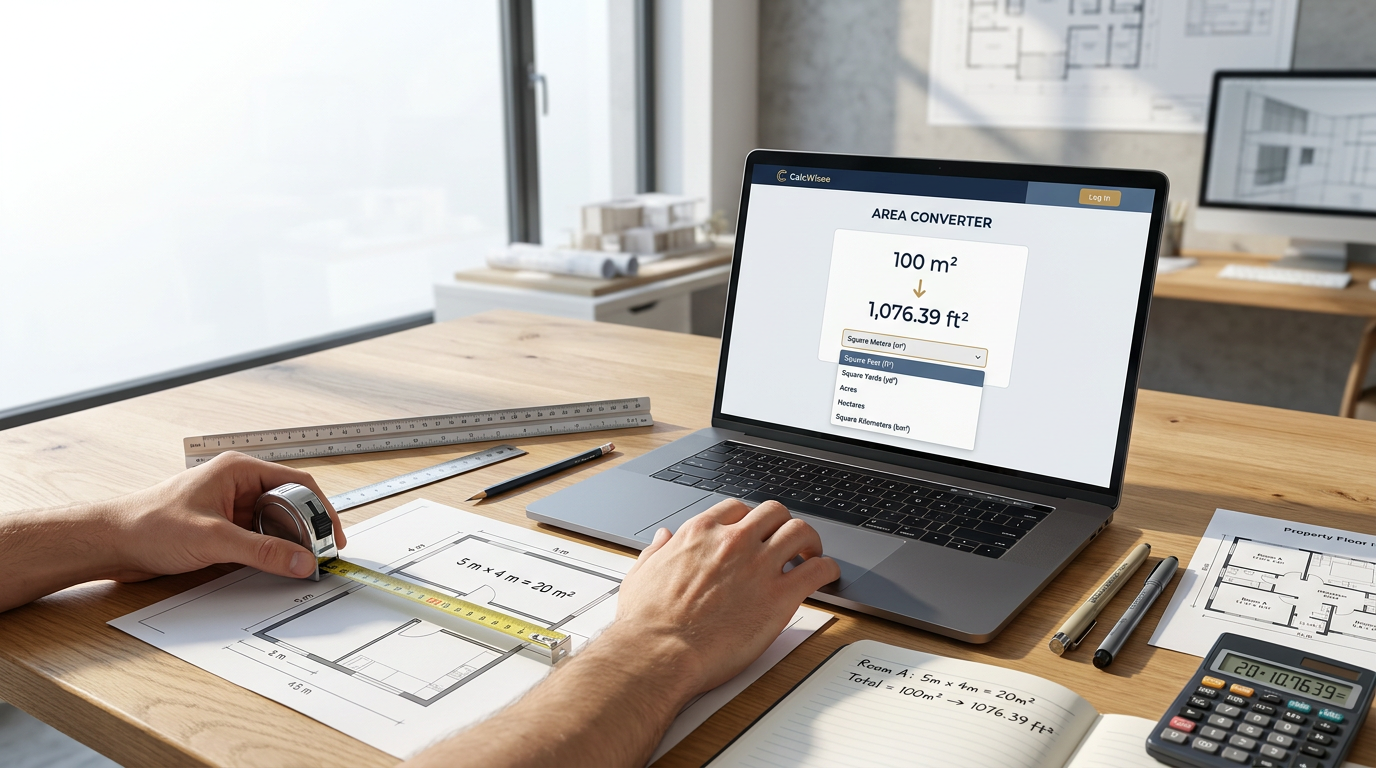
Area Converter: Convert Square Units Quickly and Accurately
Convert square meters, square feet, acres, hectares, and more with a free Area Converter — plus formulas, worked examples, a conversion table, and practical tips.
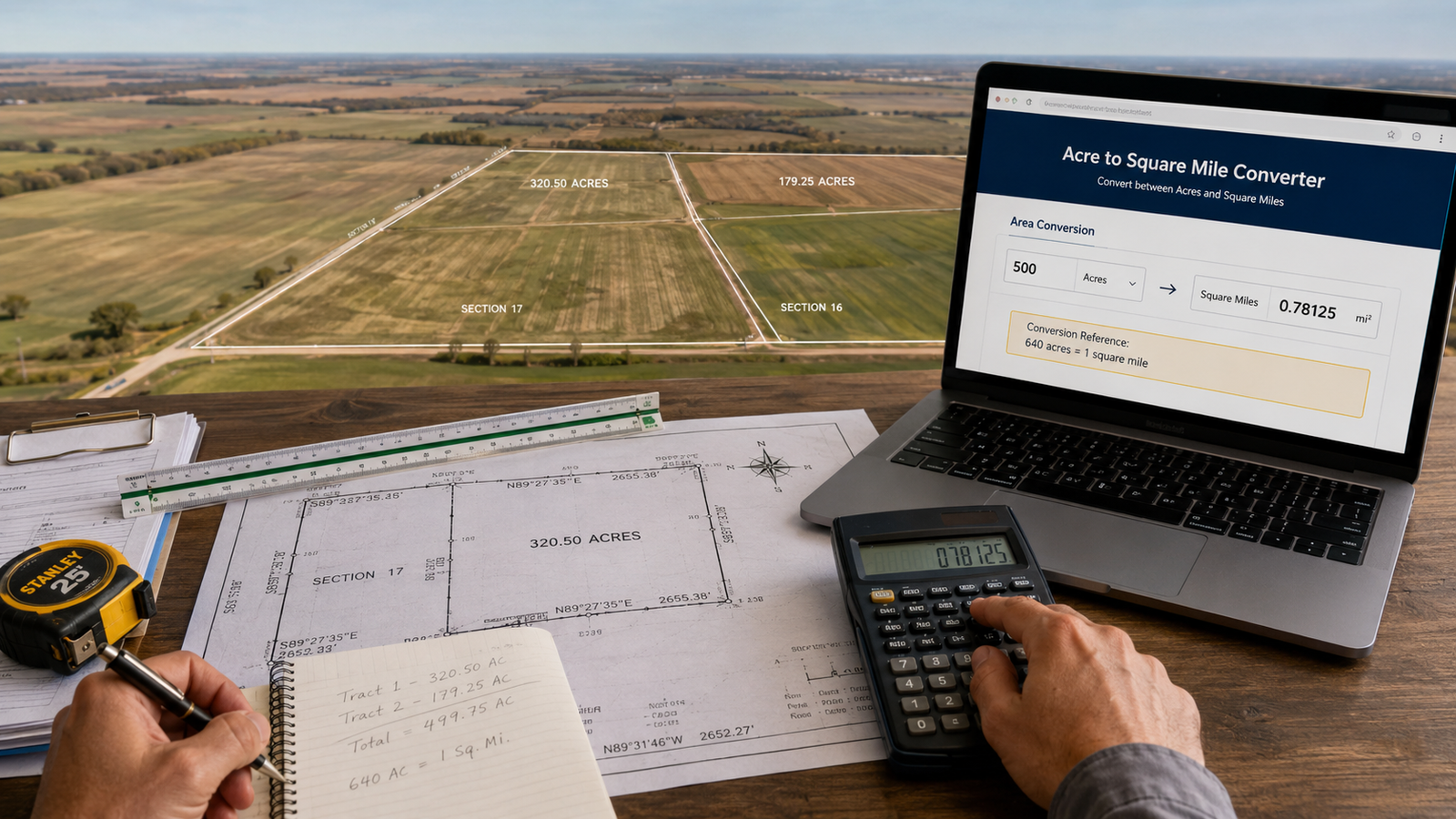
Acre to Square Mile Converter: How to Convert Land Area
Convert acres to square miles and back with the exact 640:1 factor — formulas, worked examples, a conversion table, and a free interactive land area converter.