Area Calculator: How to Calculate Area Accurately
Learn how to calculate area accurately for rectangles, squares, triangles, circles, and trapezoids — with formulas, units, examples, and a free interactive Area Calculator.
Whether you are tiling a floor, quoting a paint job, sizing a garden bed, or solving a geometry problem, you need a reliable way to calculate area. An Area Calculator turns length and width (or radius, base, and height) into square units in seconds — without messy arithmetic or unit mix-ups.
This guide explains what area is, the most common area formulas, how units work, where area calculations show up in real life, and the mistakes that throw results off. You can also use the free Area Calculator on CalcWisee for rectangles, squares, triangles, circles, and more.
What Is Area?
Area is the measure of the two-dimensional surface enclosed by a shape’s boundary. It answers “how much space does this surface cover?” — not how long the edge is (perimeter) and not how much space a solid fills (volume).
Because area is two-dimensional, it is always expressed in square units: square metres (m²), square feet (ft²), square centimetres (cm²), acres, hectares, and so on. One square metre is the area of a square that is one metre on each side.
- Length and width describe edges; area multiplies compatible dimensions.
- Larger shapes have larger area when units stay consistent.
- Irregular regions can often be split into simpler shapes whose areas add up.
What Is an Area Calculator?
An Area Calculator is a digital tool that applies the correct geometric formula for a chosen shape, multiplies or combines the dimensions you enter, and returns the area in square units. Good calculators also support unit labels (metres, feet, inches) so you can keep inputs consistent.
On CalcWisee, the Area Calculator is free, runs in your browser, and updates as soon as you enter valid dimensions. It is built for students, DIYers, contractors, and anyone who needs a quick, transparent result.
- Pick a shape (rectangle, square, triangle, circle, and related forms).
- Enter the required dimensions in matching units.
- Read the area instantly, with a clear square-unit result.
Try it right here — results update instantly.
Area
0 units²
Common Area Formulas
Every standard shape has a closed-form area formula. Memorise the five below and you can handle most classroom and job-site problems. The table summarises formula and a quick example; the subsections walk through each shape.
| Shape | Formula | Example |
|---|---|---|
| Rectangle | A = length × width | 8 m × 5 m = 40 m² |
| Square | A = side × side (s²) | 6 ft × 6 ft = 36 ft² |
| Triangle | A = ½ × base × height | ½ × 10 × 4 = 20 units² |
| Circle | A = π × r² | π × 3² ≈ 28.27 units² |
| Trapezoid | A = ½ × (a + b) × h | ½ × (6 + 10) × 4 = 32 units² |
Rectangle Area
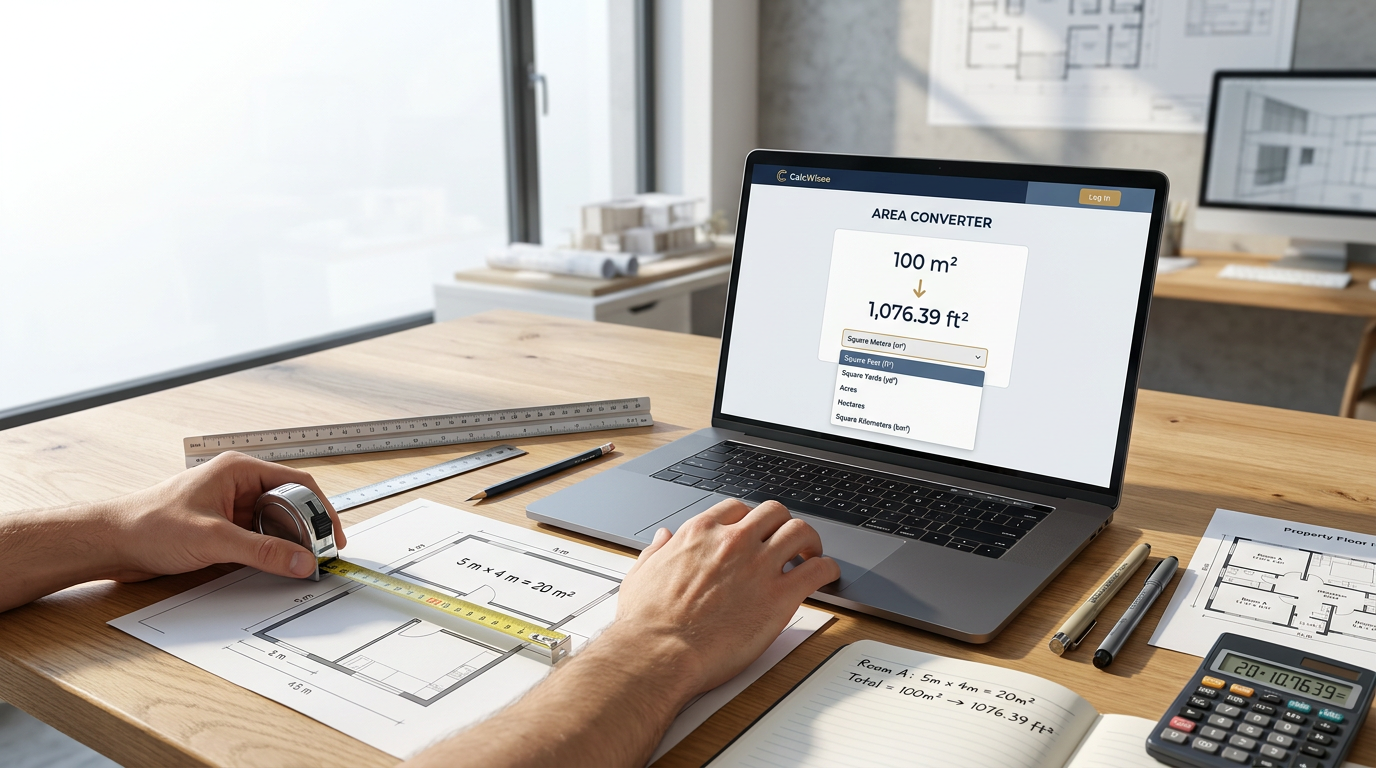
A rectangle has four right angles and opposite sides equal. Area is length times width: A = l × w. Example: a room 8 m long and 5 m wide has area 40 m² — the same figure shown on many floor plans and paint estimates.
Square Area
A square is a special rectangle with equal sides. Area is side squared: A = s². Example: a patio tile 0.5 m on each side covers 0.25 m²; sixteen such tiles cover 4 m².
Triangle Area
For any triangle, area is half the product of base and corresponding height: A = ½ × b × h. The height must be perpendicular to the chosen base. Example: base 10 m and height 4 m → A = 20 m².
Circle Area
Circle area uses the radius r (half the diameter) and π ≈ 3.14159: A = πr². Example: radius 3 m → A ≈ 28.27 m². If you only know diameter d, use r = d/2 first. Related tools like the Unit Converter help when radius is given in inches but you need square feet.
Trapezoid Area
A trapezoid (trapezium) has one pair of parallel sides a and b. Area is the average of those bases times height: A = ½(a + b)h. Example: parallel sides 6 m and 10 m, height 4 m → A = 32 m². This formula is common for irregular lots and roof sections.
Area Units
Area units are square versions of length units. Always convert lengths to the same unit before multiplying. Mixing feet and inches without conversion is one of the most common sources of error.
- Metric: mm², cm², m², km²; land often uses hectares (1 ha = 10,000 m²).
- Imperial / US customary: in², ft², yd²; land often uses acres (1 acre = 43,560 ft²).
- Use a Length Converter to align edge measurements, then compute area, or convert square units with the Unit Converter.
Example conversion: 40 m² × (10.7639 ft²/m²) ≈ 430.6 ft². For percentage markups on material waste, pair area results with the Percentage Calculator.
Where Is Area Calculation Used?
Area shows up anywhere a surface must be covered, coated, priced, or compared.
Home Improvement
Flooring, carpet, tile, paint, wallpaper, and decking are sold by area. Measure each room as a rectangle (or split L-shapes), add areas, then add a waste percentage. Accurate square footage prevents under-ordering and costly leftover stock.
Construction
Contractors estimate concrete slabs, roofing squares, drywall sheets, and site coverage from plan dimensions. Surveyors and estimators rely on consistent units and verified formulas so bids stay competitive and safe.
Landscaping
Sod, mulch depth planning (volume needs area first), fertilizer rates, and irrigation coverage all start with lawn or bed area. Irregular beds are often approximated as trapezoids or combinations of rectangles and circles.
Education
Students learn area as a foundation for geometry, algebra word problems, and later calculus. An interactive Area Calculator lets learners check homework and build intuition for how each dimension scales the result.
How to Calculate Area Step by Step
- 1Identify the shape (or split a complex outline into rectangles, triangles, and circles).
- 2List the dimensions the formula needs (length and width; side; base and height; radius; or two bases and height).
- 3Convert every length into the same unit using a Length Converter if needed.
- 4Apply the matching formula from the table above (or enter values in the Area Calculator).
- 5Label the answer in square units and round only at the end for estimates.
- 6For materials, add waste (often 5–15%) with the Percentage Calculator.
Worked example: a rectangular deck is 12 ft by 16 ft. Area = 12 × 16 = 192 ft². With 10% waste → 192 × 1.10 = 211.2 ft² of decking to order.
Common Area Calculation Mistakes
- Mixing units (inches with feet, or cm with metres) before multiplying.
- Using diameter in the circle formula instead of radius (or forgetting to halve diameter).
- Using a non-perpendicular “height” for a triangle or trapezoid.
- Forgetting that area is square units — reporting “40 m” instead of “40 m²”.
- Double-counting or omitting sections when summing rooms or lots.
- Rounding intermediate steps too aggressively and compounding error.
Area vs. Perimeter
Perimeter is the total length of the boundary (one-dimensional). Area is the space inside (two-dimensional). A 4 × 6 rectangle has perimeter 2(4 + 6) = 20 units but area 24 square units. Fencing depends on perimeter; flooring depends on area. Do not use one formula when the project needs the other.
Area vs. Volume
Volume measures three-dimensional capacity (cubic units). A room’s floor area might be 40 m² while its air volume is area × ceiling height. Concrete, soil, and tank capacity need volume; paint coverage and carpet need area. Convert length carefully with the Unit Converter before multiplying a third dimension.
Frequently Asked Questions
What is the formula for area?
There is no single formula for every shape. Rectangles use length × width, squares use side², triangles use ½ × base × height, circles use πr², and trapezoids use ½(a + b)h. Choose the formula that matches your shape, or use an Area Calculator that applies it for you.
What unit is area measured in?
Area is measured in square units such as square metres (m²), square feet (ft²), square centimetres (cm²), acres, and hectares. The unit must match the length units you multiplied (metres × metres → m²).
Can an Area Calculator calculate different shapes?
Yes. A capable Area Calculator supports multiple shapes — typically rectangles, squares, triangles, circles, and often trapezoids or other polygons — each with its own inputs and formula.
How do I calculate the area of an irregular shape?
Divide the irregular region into simpler shapes (rectangles, triangles, semicircles), calculate each area separately, then add the pieces. Subtract holes or cut-outs the same way. Survey-grade work may use coordinate geometry or professional measurement.
Why is area expressed in square units?
Area describes a two-dimensional surface. Multiplying two lengths produces a square measure: one metre by one metre is one square metre. Linear units alone cannot represent coverage.
Is an Area Calculator accurate?
Yes — when you enter correct dimensions in consistent units and select the right shape. The calculator applies standard geometric formulas with ordinary floating-point precision. Measurement error in the field is usually larger than calculator rounding.
Related CalcWisee Tools
Continue with these free tools on CalcWisee:
- Area Calculator — rectangles, squares, triangles, circles, and more
- Unit Converter — length, area, volume, and other unit families
- Length Converter — metric and imperial lengths
- Percentage Calculator — waste factors and markups
- Time Calculator — project duration math
- Conversion calculators hub — all conversion tools
- CalcWisee home — full calculator directory
Helpful External Resources
- NIST — National Institute of Standards and Technology — measurement standards and SI guidance
- National Council of Teachers of Mathematics (NCTM) — teaching and learning resources for geometry and measurement
Accuracy Note
Results from the Area Calculator depend on the accuracy of the dimensions you enter and on choosing the correct shape formula. Field measurements should use a reliable tape, laser distance meter, or plan scale. For legal surveys, structural design, or regulated construction quantities, verify figures with a qualified professional and official drawings. CalcWisee tools are educational and practical aids, not a substitute for professional engineering or surveying services.
Conclusion
Calculating area accurately comes down to the right formula, consistent units, and careful measurement. Rectangles, squares, triangles, circles, and trapezoids cover most everyday needs; irregular outlines become manageable when you split them into simple pieces.
Use the free Area Calculator to check your work instantly, convert supporting measurements with the Length Converter and Unit Converter, and explore more tools on the CalcWisee hub whenever your next project needs a clear number.
Try it yourself
Put this guide into practice with our free tool.
CalcWisee Editorial Team
Calculator development and formula review
CalcWisee is an independent site founded by Ayman. Every calculator is built from a published formula or official definition, tested against hand-worked examples before it goes live, and corrected promptly when a reader reports an issue to ayman@calcwisee.com.
Expertise: Financial mathematics, Health and fitness formulas, Applied mathematics, Unit conversion standards